A Conversation With Dr. Collins
By Lily Rice
Editor’s note:
This article was originally published in the October 2026 issue of the Nevada Native Plant Society’s newsletter. You can check out the newsletter and all of the great things happening within the society here.
Many scientific discoveries occur thanks to the simple fact that someone happened to be at the right place at the right time, often for the wrong reasons. New populations of plants are discovered quite frequently because someone lumbered into the backcountry and looked down at the exact right moment to see something unfamiliar, leading them to ask the question, “what in the world am I looking at?” That question can lead you down the rabbit-hole many of us find ourselves willfully crawling into, depositing us in our own wonderland of academic journals speaking at length on the taxonomic changes of a cryptic group of plants. This is exactly what happened to me in early May, where outside of Pioche, NV in the rolling drainages of the Mojave Transition Zone I carried my camera hoping to take pictures of Centrostegia thurberi, but instead glanced the deep-purple inflorescence of an alien holoparasite, Aphyllon arizonicum. Historically, this species was not thought to have occurrences in Nevada, but recent evidence is mounting that there are more populations hidden around pickle-scented subshrubs waiting for discovery. Many thanks to Jerry Tiehm and Dr. Alison Colwell for putting me in contact with the authority on this species, Dr. Turner Collins, who gave me the absolute pleasure of picking his brain on the tricky taxonomy of Aphyllon.
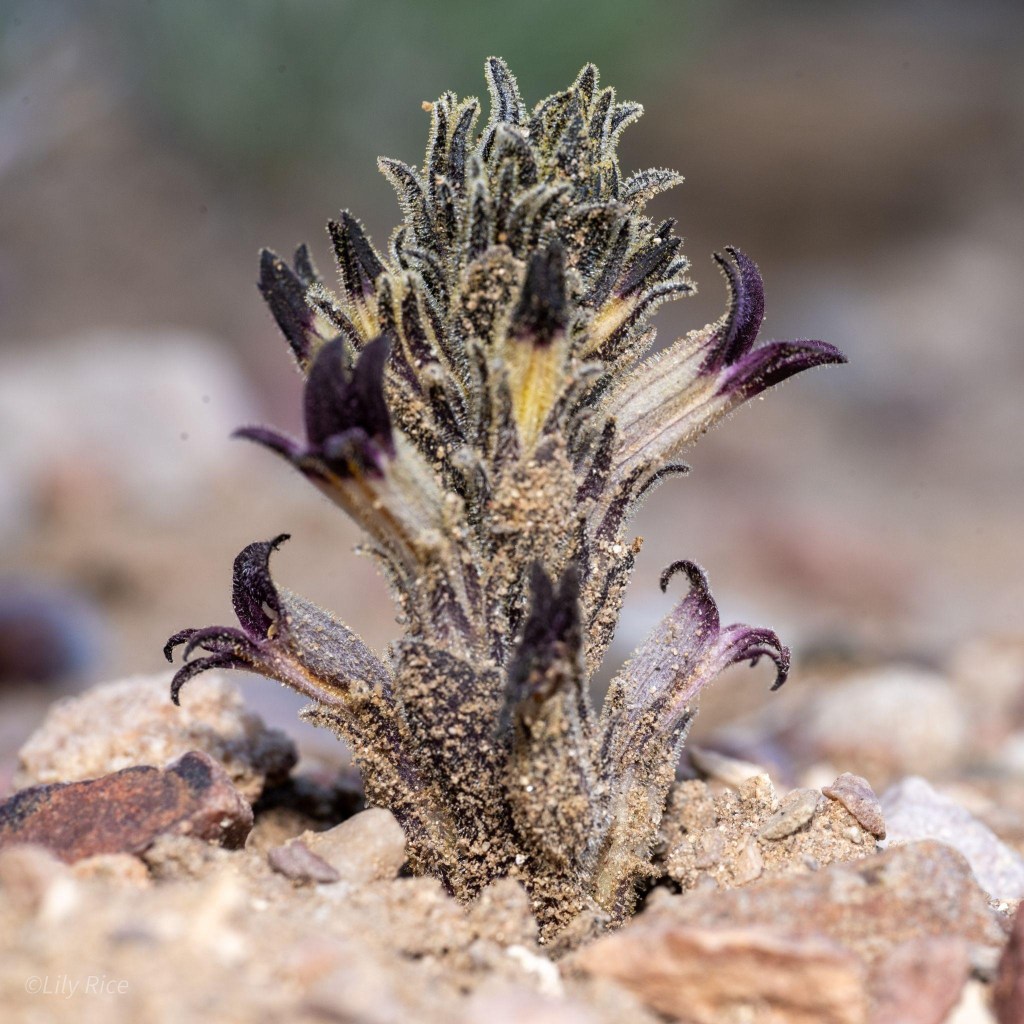
wash outside Pioche, NV. ©Lily Rice
Dr. Turner Collins was born in 1937 in Polk County Texas. Before becoming the authority on four species of Aphyllon, he taught high school science class in Shepard, Texas for 5 years, was the principal, and even served as the acting superintendent for 1 year. Currently, he is Professor Emeritus at Evangel University, where he taught as a professor for 33 years before retiring from teaching, but not from his love of research. To this day he is still publishing, and he and his colleagues are currently awaiting a publication in the Linnean Society about a new species of Kopsiopsis from Baja California. His post-graduate work has focused on the resurrected genus known as Aphyllon, a genus with a troubled taxonomic history. His history with this genus dates back to his 1966 master’s dissertation, “Vascular Flora of the Concho Bluff Ecotone,” where being in the right place at the right time brought him into admiration with plant parasitism.
Dr. Collins: “Well, in these sand dunes, I discovered the largest population of Orobanche that I have seen to date.
I mean, just hundreds of plants in more than one location, and I had never seen a root parasite, and I got fascinated with them.”
Down the rabbit-hole he went.
On the other side the Orobanche ludoviciana complex awaited him- a tangled web of specimens across time, space, and morphology- a worthy foe for his doctoral dissertation. Confoundingly, the complex proved complex thanks to the lack of available resources.
Dr. Collins: “I couldn’t find anything other than P.A. Munz’s 1930 paper which didn’t answer my questions, and I went from there.”
Since then, Dr. Collins and his collaborators have teased apart the Orobanche ludoviciana complex, revealing a web of distinct taxa, in which Orobanche arizonica was identified. In revealing these distinct lineages, the evidence began to mount that the new-world sections of Orobanche belonged to a genus all on their own, the resurrected Aphyllon. Dr. Collins, along with his colleagues Dr. George Yatskievych and the aforementioned Dr. Colwell, were responsible for the treatments for Orobanche in the Flora of North America project, where the mounting evidence troubled them.
Dr. Collins: “We felt like it’s just going to be a nightmare for us to back up and rewrite and do all the taxonomy and do all the synonyms and so forth. It would almost be like starting over… I’ve always felt like they should have been separated just based on morphology, because the flower structure of the Eurasian species is very different from the flower structure of the North American species.”
As always with taxonomic history, it’s filled with a list of names reassembling branches on the tree of life as one might reconstruct a Lego set. Aphyllon was first described by John Mitchell in his 1769 work, “Dissertatio brevis de principiis botanicorum et zoologorum.” In 1876, the preeminent Asa Gray put his prescient nickel down, lumping all of the New-World Orobanche into the genus Aphyllon with two sections, Aphyllon & Nothaphyllon. Shortly after, Günther Beck-Mannagetta’s 1890 work, “Monographie der Gattung Orobanche,” subsumed the genus Aphyllon into Orobanche, where it stayed for many years, but the taxonomic quibbling would not stop. The famous Per Axel Rydberg launched into the fray in 1906, with an unsuccessful proposal to make Gray’s Nothaphyllon section into its own genus, Myzorrhiza. Flash forward to 2016 where Dr. Adam Schneider utilized molecular phylogenetic evidence to separate the new-world Orobanche sections Gymnocaulis & Nothaphyllon into their own sections under the genus Aphyllon, sect. Aphyllon & Nothaphyllon respectively (Schneider, 2016), upholding Gray’s delineation.
For our species of focus, A. arizonicum, its history is (thankfully) more succinct. The type specimen for the species comes from the 1935 Flora of Arizona by Kearney and Peebles who added a note to a specimen of Aphyllon cooperi stating, “this looks different,” (Collins & Yatskievych, 2015). Many collectors would continue to be confused by A. arizonicum, mislabeling them as various members of Aphyllon, most frequently A. cooperi, A. ludoviciana, or less frequently A. multiflora. Dr. Collins had his first contact with the species as a graduate student in 1969 where on a field trip he found a specimen he presumed to be a small-flowered A. cooperi, “…which had stayed for a long time until I worked on the Flora of North America, and I began to see things I hadn’t noticed before.” During the team’s work on the FNA treatments for Orobanche, the team had 5 or 6 cabinets reserved in the Missouri Botanical Garden, filled to the brim with maybe five or six-thousand Orobanche specimens on loan, of which, somewhere around the ballpark of 45 sheets were identified as this mysterious small-flowered A. cooperi. Cue the 2015 paper- one year before Dr. Schneider’s Aphyllon necromancy- by Dr. Collins and Dr. Yatskievych where A. arizonicum was announced to the botanical world (Collins & Yatskievych, 2015). Since then identifications and collections have popped up mostly across the four corners of Utah, Colorado, New Mexico, and Arizona; and recently, eastern Nevada.
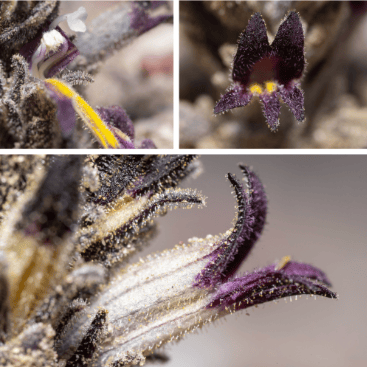
characters starting with top left: 1. anthers lacking
distinct glands 2. narrow-acute corolla lobes without
an apiculate tooth and noticeable yellow palatal folds
3. glandular, cream-colored tube leading to deeppurple, reflexed lobes. ©Lily Rice
Currently, there are three sightings of this species in Nevada. The first is a specimen north of Elko, NV that is a collection by A.H. Holmgren from 1941, that was relabelled to A. arizonicum in late May 2026. Second, an INaturalist observation by user “duncan-bell” near Jean, NV in late April 2022. Finally, my recent addition to the species’ Nevadan range-expansion near Pioche, NV in early May 2026. At the time of seeing this species, I was inundated by species in eastern Nevada that were sparsely showing up on INaturalist, which struck me as odd because they seemed to be apparent on the landscape. My conclusion was that these organisms weren’t truly that uncommon, just that there weren’t many botanical eyes out east to see them. I figured this might be the case with A. arizonicum as well. In my conversation with Dr. Collins, that hypothesis tapped into some support, as a haustorial root might tap into a host.
Lily: “Do you think it’s in recent times that Aphyllon arizonicum is making its way out westward and expanding its range or…?”
Dr. Collins: “No, I think it’s another one of those cases where it was hiding in plain sight. You know, my description of Aphyllon riparium, 30 years ago, it had been right there in plain sight and completely misunderstood for over a century. But when I got into it, it was clear that it was not Orobanche ludoviciana, which is what it had been called.”
I think it appropriate at this time to share a quote that Dr. Collins’ first taxonomy professor would proclaim, which he lovingly shared to this budding taxonomist: “Species do not exist in nature. They only exist in the minds of taxonomists.”
From Dr. Collins’ taxonomic mind we gained several characters with which we might distinguish A. arizonicum from the closely related A. cooperi. A. arizonicum is an annual holoparasite specialized to Gutierrezia sarothrae instead of species of Ambrosia, has shorter corollas (15-20mm vs. 16-32mm), has aglandular anthers, typically flowers in summer instead of late-winter to spring, has narrow-acute corolla lobes that lack an apiculate tooth (unlike A. cooperi), and its range is mostly above the Mogollon Rim at higher elevations (> 1,500m) instead of below the Mogollon Rim at lower elevations (< 1,000m) (Collins & Yatskievych, 2015).
In closing, I asked Dr. Collins if he might have any advice to botanists who want to try and find more occurrences of A. arizonicum in Nevada.
Dr. Collins: “I would say anywhere that you find relatively loose sand, even sand dunes, and there’s Gutierrezia, that’s a likely place to keep an eye out for… look for the host first, and then when you find a spot with the host species, you start poking around.”
There you have it, your guiding light from the authority on the species. If you find yourself in eastern Nevada during summer with a hankering to find new populations, get out there and find some populations of Gutierrezia- whose herbage I find to smell reminiscent of pickled cucumbers- and you may be the next person in long line of botanists remarking upon an alien-looking Aphyllon. If I may quote the highly unscientific 90s television show, X-Files, “The truth is out there.”
Works Cited
Collins, L. T., & Yatskievych, G. (2015). Orobanche arizonica sp. nov. And nomenclatural changes in Orobanche cooperi (Orobanchaceae). Phytoneuron, 48, 1–19.
Schneider, A. C. (2016). Resurrection of the genus Aphyllon for New World broomrapes (Orobanche s.l., Orobanchaceae). PhytoKeys, 75, 107–118. https://doi.org/10.3897/phytokeys.75.10473


Leave a Reply