A lesson on resiliency
- Resistance, Resilience, and Building Joy; a Prelude.
- Sonoran Desert, a Tangent
- Mojave, A Brief, Deep History
- Death Valley National Park
- Ash Meadows
- Spring Mountains
- Avi Kwa Ame National Monument
- Mojave National Preserve
- Valley of Fire State Park
- New Beginnings, Perhaps Hope
Resistance, Resilience, and Building Joy; a Prelude.
November 6, 2024 was a day which shall never leave my remembrance, an extraordinary claim seeing as my memory of the first 20 years of life are filled with tremendous gaps and wobbly timelines. On this day, I sat in my temporary office within the Humboldt-Toiyabe National Forest building located in Sparks Nevada, this region of what most call Reno always seeming to possess a smell somewhere between cinnamon toast crunch and freshly poured asphalt. The entire day, the federal employees, glued to their work, kept silent. It was as if a single utterance would break the impossible trance we all were in; ahead of us a yawning future of uncertainty, where all of our careers would be troubled and the lands and ecosystems we studied and protected equally at risk. I remember watching my home state be called for Trump and feeling that expanse of infinite possibilities ahead of us coalesce into an absurd, desperate finitude. November 7, 2024, another day I can never forget, I was greeted quite early by my supervisor- a loveable curmudgeon whose spine had forced his pride into dependence on a cane- this was an unusual appearance. He was making his rounds to everyone in his department, especially his female or queer employees, and checking in with us and apologizing for that absurd, desperate finitude ahead of us in Trump’s second term. Many of the people I once worked with at the USFS have since been fired, forced out, or left. I, a temporary contractor through a non-profit, could offer no resistance, only sympathy to the people I had hoped would resist the greedy policies that would soon be shoved down their throats. Their careers, once focused on conservation, restoration, and sustainable management, faced a federal push towards a new norm.
My partner researches community building through the lens of punk philosophy and queer theory. A lot of their work discusses the importance of generating joy in queer spaces- queer in this sense meaning outside of the normative structure within a society, not just identifying as LGBTQ+, although that certainly fits the bill- and not just focusing on resistance as a source of joy. If you have been a part of my life through this dystopia we call the internet since November of 2024, you’ll know I have been quite vocal about the Trump administration. I have been fulfilling the outdated “resistance” definition of queer joy. I left Nevada in early 2025 as my jobs within botany suddenly had their funding pulled and my family feared the maliciousness of the federal government. That absurd, desperate finitude reared its ugly head. Since then, resiliency and community building through acts of resistance has been my life, and just recently I felt a glimmer of hope as queer joy has been blossoming once again.
Botany is a dying field, coming under attack by academic institutions such as the Duke University with the closing of its historic herbarium (We’ve Grown the Future of Botany Here. Why Are We Cutting Its Roots?, 2025); or, from the current Trump Administration, with the attempt to alter the endangered species act in favor of more permitting for energy production (Court Overturns Trump Administration Regulations That Weakened Endangered Species Act, 2026.), or pulling funding for projects that mention climate change (Milman, 2025), or firing the entire board at the National Science Foundation (Trump Fired The Entire National Science Board. Here’s Why That Matters, 2026), etcetera; you get the point. Being a botanist- or really any naturalist at this point in time- is queer. To stand against the normative pressures of our culture and say, no, these species deserve our recognition, reverence, and protection, is queer; all U.S. naturalists face a queering of their professions by the normative societal pressures, to which we must adapt to. While there certainly is a lot of resistance that’s inherent to this profession, joy effuses our community. To quote Mary Winter, a Nevadan botanist who recently passed:
To call a thing by name
To know the read of the wind
And the bend of the river beyond
Is to be on home ground.
To know a plant by name is to feel akin to the space you live in, to build a community with the voiceless, to become more familiar with the lessening unknown. I recently made the decision to accept another field season with the Great Basin Institute, where I will be performing seed collection work in eastern Nevada. This required me to once again leave my family and step into the unknown, a thrilling yet terrifying premise, but one promising to know another home ground, especially one I have loved and lost. California-Nevada is quite possibly the most beautiful land that I have ever come to know. Losing it last year filled me with such agony and longing as I moved back to the unqueer space of Ohio, where stroads reign dominant, forgoing their love of the life-world long ago.
Oh, great, glorious Nevada how I weep in your absence.
Every day I am bereft of your beauty,
Every night I dream of being in your warm embrace.

Your endless sea of longitudinal mountains,
Inspire me to keep searching,
Through every band of elevation.

Your expansive stretch of yawning valleys,
A ghost of the ancient Lake Lahontan,
Encrust my mind with saline admiration.

Your Technicolor views for which I'm so fond,
Have wounded me so dearly,
Resplendent Cypripedium pales beneath you.

Oh, great, glorious Nevada how I've withered in your absence.
Every day I am bereft of your beauty,
Every night I hope to wake back in your embrace.

-Lily Rice
I cannot begin to explain the feelings of unbridled joy as I passed the 100th meridian, smelled again that pine-earth petrichor in Reno, and witnessed the desert in bloom once again. So, let us collectively shed the weights of resistance and resiliency for just a moment and immerse ourselves in a pure appreciation of the flora of the Mojave Desert.
Sonoran Desert, a Tangent
While the main focus of this blog post is the Mojave Desert, I necessarily HAD to make a stop through Wikieup, Arizona to see a population of the most enigmatic cactus, Carnegiea gigantea.
The Sonoran Desert is the only location in the world where this giant succulent not only lives, but thrives. Compared to the nearby Mojave Desert, the Sonoran Desert is both wetter and hotter, and has a subtropical climate with warm winters and seasonal rainfall. The Sonoran Desert spans from southern California, east into Arizona, south into Baja California and down along the coast of the Mexican state of Sonora.

When I visited this population of Saguaros in late March the temperature was already into the 90s and the Arizonan sun was cruelly kissing my skin. Nonetheless, the slopes around Wikieup were flush with flora. The plant community here was dominated by Larrea tridentata, Parkinsonia microphylla, Neltuma spp., Fouqueria splendens, and of course, Carnegiea gigantea. Named after steel-baron & union-buster later turned philanthropist, Andrew Carnegie, who helped fund the founding of the Desert Botanical Laboratory, located in Tuscon, AZ (Carnegie’s Cactus: Carnegie Gigantea, 2026.); while sentimental, sure, I still stand wholly against naming organisms after people. The name Saguaro comes apparently from a Hispanic bastardization of the indigenous O’odham word, “ha:san” pronounced “huh-shahn” (Saguaro Cacti at Saguaro National Park (U.S. National Park Service), 2026.), (Manuel, 2023), who traditionally have harvested the fruit to make into wine for many centuries.
While not the tallest nor largest cactus species, the Saguaro is not to be taken lightly. Saguaros are a slow-growing cactus that can reach around 50 feet tall. The characteristic “arms” of the Saguaro don’t usually start appearing until 50 to 100 years old; a long-lived species, C. gigantea can potentially reach 200 years of life under the Sonoran sun (The Saguaro Cactus (U.S. National Park Service), 2026). Saguaros are a keystone species in the Sonoran Desert, providing food, water, and shelter for various animals. In the pictures above you can see holes dotting the stems of the giant saguaros. Several bird species will core out sections of the Saguaro to make nests, a cool, shady refuge from the baking sun.
Other species of note at this site in Wikieup, AZ were Nemacladus orientalis– a diminutive member of Campanulaceae- and Penstemon parryi, displaying a very hairy staminode.


With my desert-thirst slaked by Saguaro, I made the final plodding steps of my journey back into Nevada, the land where rainbows hide.
Mojave, A Brief, Deep History
The windows of your 2015 jade-green Subaru Forester are down with the speakers blasting “Japan” by Psychedelic Porn Crumpets. You are travelling at 82 miles per hour through a valley of radiant-yellow Larrea tridentata and weathered granitic batholiths gleam a hazy white on the horizon; 100 million years have grinded by to bring you here: you feel alive.
The Mojave desert is a surreal environment in spring. Normally at 80 degrees Fahrenheit in March, this time it was a “comfortable” 90-100. Despite this early heat, the valleys and mid-slopes were erupting in color, the plant communities desperately trying to take advantage of a wetter-than-average winter and hotter-than-average spring before their chance to pump out seeds comes to a crispy end. There are many different plant communities that checkerboard the Mojave landscape, but, as a broad overview, the dominant Mojave flora are Yucca brevifolia & Y. jaegeriana, indicator species of the Mojave; Larrea tridentata, and several cacti species such as: Cylindropuntia echinocarpa, Opuntia basalaris, and Homalocephala polycephala. While these species are dominant community builders, quite possibly the most common plant habit is winter annual. When the growing season is both short and irregular, spending all of your energy into reproduction is a very effective strategy. This may not come as a big surprise, but by far the most successful taxonomic group in the Mojave is the Asteraceae, much of which choose that winter annual habit. In the following sections there will be a broad diversity of this family laid out before you.
But, before we get into the thick of it, I would be doing this region a grand disservice if I did not mention its geologic history; after all, geology is a main determinant of plant community type. The Mojave desert’s geological origin began at the same time the Great Basin was forming due to the subduction of the Farallon Plate, which I covered in greater detail in my blog post here, but for a brief review:
The Mojave Desert is largely composed of volcanic and sedimentary deposits, much of which is granite or carbonate materials. Although there is certainly a bit of diversity in geological material, the oldest materials are metamorphic between 1.7 and 2.5 billion years old (Our Dynamic Desert, 2026). Lasting up to 275 million years ago (mya), for 800 million years prior, sedimentary deposits built up, creating the large sections of carbonate materials found in the Mojave today. At 275 mya faulting and folding resulted in the Cordilleran range formation, uplifting the formerly hidden oceanic sediments. In the Jurassic and Cretaceous periods, with the subduction of the Farallon Plate under the North American Plate, deep granitic batholiths formed which would later be uplifted with the extensional faulting of the Nevadaplano. Speaking of, around 30 mya, a complicated fault system began to form basins and ranges, which would become the ranges found in the Great Basin and Mojave Deserts. Today, the Mojave has more in common with the fault systems in the San Andreas Fault than that of the more northerly Great Basin Desert (Our Dynamic Desert, 2026). Finally, ash deposits from volcanic eruptions occurred during the late Tertiary and Quaternary periods, filling many of the fans and basins with tuff (Our Dynamic Desert, 2026). The rain shadow formed from the Sierra Nevada and Coast Ranges, along with high temperatures and ever-present winds have molded the erosion of the Mojave Desert over the last million years, forming the astounding landscape we are gifted with today.
Death Valley National Park
The Approach

Despite my desires which tempted me to go directly to Death Valley, I needed to make a pit stop at my new (read: temporary) home in Ruby Valley. The drive from northeastern Nevada towards Death Valley National Park filled me with anxiety. The characteristic straw-colored slopes of rain-parched plant communities were all that I could see for five and a half hours. Despite seeing photos from other botanists who were witnessing the super bloom at Death Valley, my mind was overwhelmed with the possibility that I would be too late to see any plants in full bloom. It wasn’t until I passed the I95 exit towards Bonnie-Claire that my hopes were lifted: shock-purple splashes of Phacelia crenulata covered a roadcut. I turned up the already blaring speakers and unconsciously depressed the pedal, willing myself towards a verdant Death Valley. As I crested the hills outside Beatty a sight I was unprepared for loosened a characteristic phrase from my lips, “oh goddamn, holy fuck!”
The eastern slopes of the Grapevine Range exploded in a flush of green. Death Valley was alive and thriving. I sped along the highway until my eyes spotted a single golf-ball-sized splash of pink erupting from a low shrub; I tortured my already tortured breaks, accelerating my vehicle from 80 to 0 mph, and pulled over on the side of the road. As I stepped outside of my car I was subsumed by the Grapevine Mountains in bloom.
The Grapevine Mountains serve as the eastern border of Death Valley, rising up several thousand feet above the valley floor below. The plant community here on the eastern slopes share some similarities to that found within the park- especially at the higher elevation points within the Panamint Range as you’ll see later- but gains the benefit of being a little cooler and less wind-whipped. These slopes were a phenomenal primer for my weeklong foray in Mojave flora.
The splash of pink was what I hoped it to be, one of the enigmatic western members of the lily family known as the “mariposa lilies,” Calochortus flexuosus. This genus is widely successful across the intermountain west, with most of its diversity located in the Sierra Nevada range, but no slouch when it comes to diversity in the rest of the western cordillera. Perhaps the most notable (and keyable) feature of Calochortus are the ornamentations on the adaxial sides of the tepals. Both petals and calyces display splashes of hair and color, but usually the showier petals possess more intricate details. Present on the petals of Calochortus are visible glands that can be quite variable. Some are shaped like a lima bean, others like a simple circle; some are covered in a thin membrane, others are coated in tiny papillate-like protrusions known as processes; and some have a fringy margin bordering the gland. Furthermore, many mariposas have hairs either surrounding or partially bordering the glands, with splashes of color on several areas immediately surrounding the gland. There’s quite a surprising diversity of ornamentation with Calochortus, and most have a certain yonic quality to them that would inspire Georgia O’Keefe to grab her paintbrushes.
For this mariposa lily, C. flexuosus, the glands are coated in a dense mat of processes, and a thick crescent of yellow coloration spans across. Sparse hairs jut out on either side of the gland like a teenagers first pubescence. A deep triangle of violet sits above the gland, and a thin patch of violet sits below it. Can you see these details as described? Keying out Calochortus depends on it.

The survival strategy of C. flexuosus is one which many perennials in the desiccating desert take on. Quite often you’ll witness the slender stem of C. flexuosus snaking its way through the shady understory of a nursery-shrub until it has enough energy to erupt from the top and open its cup-like flowers, beckoning pollinators to land and rest their sun-scorched wings. In the picture below, the Calochortus is using the shade of a Lycium shrub. C. flexuosus flowers are generally a lilac to a pink-hued white coloration. The population on the leeward slopes of the Grapevine Range were lilac, and later at Red Rocks Canyon I saw a population of the white coloration.


Before we descend several thousand feet into the Park proper, I must mention some of the other plant community members here. As mentioned above, Lycium andersonii was a dominant shrub on the slopes, a member of the nightshade family, Solanaceae, displaying an unusual shrub habit for the family. Phacelia vallis-mortae was very common both here and within the park proper. The more southerly larkspur, Delphinium parishii grew along the roadway alongside Aliciella latifolia. Most excitingly, the showy high-desert asparagus member with the silliest common name (blue-dicks) Dipterostemon capitatus was in full bloom. A couple of diminutive species hidden amongst the shrubbery made their appearance, Tricardia watsonii (a member of Hydrophyllaceae) Lupinus flavoculatus, and lastly, a new cactus species to me, Sclerocactus polyancistrus.


With my intrigue at full-throttle, I clambered back into my tired Subaru, crested the pass into Death Valley, and descended into a simulacrum of Dante’s Inferno.
Dead Flora
Hottest, Driest, Lowest
While Nevada may be the driest state in the union, Death Valley takes desert weather to the extreme. Death Valley holds the record for the lowest point in North America. At Badwater Basin, the earth sinks to 282 ft below sea level, and abruptly rises from the valley floor to Telescope Peak at 11, 049 ft, the highest point in the Park. Astoundingly, the highest point within the lower 48 states, Mt. Whitney at 14,505 ft, is only 50 miles away as the crow flies. The extreme disparity of elevation provides stunning views as well as a geological heat sink, keeping heat trapped within its stony confines. The hottest recorded temperature in Death Valley was in in 1913 at Furnace Creek, at a whopping 134°F, or 56.7 °C, and to this day is still the hottest recorded land temperature (World Meteorological Organization, 2025). Thanks to climate change the region is getting both hotter and drier. In late March when I arrived, the temperatures at the basin was barely over 100 degrees Fahrenheit, a whopping 20 degrees hotter than the average for this time of year. Lucky me. In terms of precipitation, this year was a banner year with Badwater Basin filled and ancient lake Manly resurrecting from its Pleistocene grave. For reference, the typical average annual rainfall is 2 inches, with some years receiving no rain at all (National Park Service, 2024). This makes this the driest location in North America. In addition to extreme geography and weather, the basins are filled with toxic leachates from erosion, such as limestone, gypsum, borax, heavy metals, etc. Despite all of this, life has found a way to adapt to these extremes and thrive in the rare instances of springtime moisture. It is said that super-bloom events like this happen maybe once every ten years. Ten years for your next chance to reproduce. Ten years to wait, your seeds baking in the soil. Ten years for your pollinators to come and find you again, a sailor lost at sea finally come home.


Most of my time at Death Valley was spent in the alluvial fans and mid-slope elevations of the Panamint Range, although I did spend some time at Mesquite Dunes, Badwater Basin, Zabriskie Point, and finally Dante’s View overlook. To keep this from turning into a travel blog, I will only reference these localities in reference to the location in which some of these plants were growing, or to give context on local adaptations.


Asteraceae, the GOAT
The most dominant taxa by far and large when it comes to diversity in DVNP is the Asteraceae, which really shouldn’t come too much as a surprise. The Asters are the most speciose plant family in the world due to their incredible adaptability. This taxa is one in which I required some encouragement to study back when I lived in Ohio; there simply weren’t many crazy asters other than the Silphium group in the Midwest. In the desert though, the birthplace of THE O.G. sunflower, Helianthus annus, asters go wild with their morphology. I hope with the species presented below you come out with a grand appreciation of the composite family.
But first, a reminder. The composite family is thusly named due to the structure of their inflorescences. Minute flowers- dubbed florets– are packed onto a larger structure known as a head, or capitulum if smaller. The heads are subtended by a whorl(s) of bracts known as an involucre, and each bract is known as a phyllary. Yes, the asters get their own special naming convention for a common plant feature, yes it is annoying. Quite often the phyllaries are an important feature when keying out Asteraceae, so pay attention to the shape, size, hairiness, and number of layers (or ranks) of phyllaries in the upcoming photos. For the florets, there are two different types: ligulate (or ray) and discoid and are quite easy to distinguish. Ligulate florets have a strap-like protrusion which is a modification of the corolla. Disk florets lack the strap-like appendage and the corollas are often shaped like 5-pointed stars. Composite heads can therefore be: ligulate (possessing only ligulate florets), discoid (possessing only disk florets), or radial (possessing both). In the following plants you will see examples of all three types.
When people travel to see the Death Valley super-bloom, more often than not what they are coming to see is the desert sunflower, Geraea canescens. This species litters most of the alluvial fans, giving the ‘sides’ of the Death Valley ‘bowl’ a hazy, yellow coloration. G. canescens produces radial inflorescences and is densely pilose, bearing soft, straight hairs across most of the plant’s vegetative parts.


Tiny, radial, and wooly, Eriophyllum ambiguum is very successful in many of the washes and slopes in the mid-to-higher elevation slopes of the Panamint Range. An annual, the beautiful wooly sunflower lives for wet years like this. Alongside Chylismia brevipes and Phacelia crenulata the Panamints are painted in vivid technicolor.

Probably the second most common aster you’ll see in Death Valley is known as Gravel Ghost, thanks to its spindly structure and white flowers, making it difficult to see at a distance in the perpetual haze. Atrichoseris platyphylla from its wide, prostrate basal leaves, produces copious ligulate inflorescences borne upon thin, reedy stems. Upon pollination, the fruit bear no wispy pappus for which to disperse their seeds, and resembles a white firework the moment it begins to explode. The genus, Atrichoseris, is also monotypic meaning A. platyphylla is the sole survivor on this branch of the great tree of life.


In the washes of the Panamint range I stumbled upon my absolute favorite aster that I have ever witnessed, Glyptopleura marginata. Another white, ligulate inflorescence sure, but the margins of the phyllaries and the leaves are what’s special here. Resembling a fractal pattern you might witness during the peak of a DMT trip, all of the leaf margins are crustose and white, which also gives the plant a frosted appearance.

Another white flowered, ligulate member of the chicory tribe, Rafinesquia neomexicana, or desert chicory, resembles Gravel Ghost in appearance. Also an aster with thin, reedy stems, what differentiates this species are the 3-ranked, long, and showy phyllaries. Each phyllary is white margined, glabrous, and sticks outwards at a 90-degree angle.

Once again, another ligulate aster, Calycoseris parryi, or yellow-tack stem. The intriguing feature on this aster is in the glandular hairs sparsely covering every vegetative surface except for the leaves. This species is one of two in its genus and the other species, C. wrightii I saw later in the Spring Mountains.


An absolute weirdo, Psathyrotes ramosissima is a densely wooly, mound forming perennial, with very showy discoid heads. The dense layer of wooly hairs helps reduce water loss by reflecting sunlight.

Lastly, a discoid aster, Chaenactis stevoides. While the florets on the margins of the head may look showy, do not be deceived, they are still disk florets.

Hydrophyllaceae, surprisingly, also the GOAT
When I passed through Death Valley National Park on my way to see Astragalus coccineus almost a year ago, I performed that expert vehicular maneuver the car-botanist knows quite well: sudden acceleration to 0 mph followed by a rapid reverse after seeing something growing on a roadside. I had seen the shock-purple helicoid-cyme of Phacelia crenulata, my first encounter with this species. Phacelia, a genus once belonging to Boraginaceae now properly placed in the family, Hydrophyllacee, bear grand resemblance to each other. Phacelia almost always have purple, cup-shaped corollas, with stamens exerted, presented upon helicoid-cymes. Quite often in this group, the stiff hairs can be irritating, with some botanists describing them akin to fiberglass under the skin; I thankfully have yet to experience this. As you look through the diversity of Phacelia here, keep an eye on the trichome diversity. As a final note, I find it immensely helpful whenever seeing a species of this genus to sing “Cecelia” by Simon & Garfunkel, with the names swapped. This does nothing materially productive, other than lodge that earworm deeper into my brain.
There are two species in Death Valley that you are the most likely to encounter: Phacelia crenulata & P. fremontii. Many of the slopes in DVNP are littered with one or both of these species. Both annuals, they compete within the same niches. P. crenulata generally stands larger than the more diminutive P. fremontii, and the eagle-eyed viewer will notice the latter species’ stamens are included within the corolla; a rulebreaker. While both are largely Mojave plants, P. crenualata‘s range extends past the Mojave Basin and Range and into the Central Basin and Range of Nevada, whereas P. fremontii barely breaks out into the Mojave transition zone between the MBR & CBR.


Phacelia vallis-morte named after its discovery in Death Valley, is actually quite broad in its range, extending through the Mojave along the borders of CA & NV, east past Vegas and into Utah and Arizona. Many times you will encounter this species in the shady-security of a nursery shrub.

P. cryptantha, named after its pseudo-resemblance to that cryptic genus, is a bristly annual with small, white flowers. I thankfully had the sense not to touch this species, and I imagine if I did I would’ve been able to relate more to the other botanists who have suffered before me. Truly, we stand on the shoulders of giants.

While not in Hydrophyllaceae, I felt it prudent to include this Boraginaceae member to display the similarities amongst the two groups. Nama demissa, or purple mat, is a low-growing annual that grows on gravelly flats in Death Valley and beyond in the Mojave. The flowers of this species looks very similar to that of Phacelia, especially P. fremontii, with purple cup-like corollas. At the time of writing Intermountain Flora (1984), Boraginaceae was placed in the order Lamilaes, and Hydrophllaceae within the Solanales, which came as a great shock to me. Since then, both are nestled (appropriately) within the Boraginales.

Onagraceae, do you hear that, its the braying of yet another GOAT
I have a bad habit with this family. Almost every time I see a member of the evening primroses, I see the 4-petaled yellow flowers and tell myself its a brassica. Almost every time another botanist will immediately say, “isn’t that in Onagraceae,” and I have to remind myself of my own lazy ignorance. So, for being the benefit of Mrs. Rice, let’s remind ourselves what an evening-primrose is before getting along with the show.
As a general rule, Onagraceae plants are variable in their leaf morphology, but their flowers are pretty consistent. Usually the flower parts are 4-merous (in parts of 4), so the carpels, stamens, calyces, and petals are all in multiples of 4. The pollen is usually dispersed through cobwebby viscin-threads, instead of thick globules or dumped out through salt-shaker like holes. Often the styles are long and the stigma tips split into 2 or 4 lobes, or becomes rounded into a club. Flowers are often yellow or white. For my own edification, the differentiating features between Onagraceae and Brassicaceae is largely that Brassicaceae is not 4-merous. Brassicas have 6 stamens that do not produce viscin-threads and the stigmas are generally not modified. Now that’s out of the way, back to DVNP.
The most vibrant and prominent onagrad in DVNP, Chylismia brevipes is an annual found on many of the slopes and washes in the mid elevations. In the pictures below you can see the viscin-threads spilling out of the dehiscing stamens and the 4-part, bulbous stigma common to this family.


In the same genus, Chylismia claviformis ssp. funerea is another common annual in DVNP. the brown spots at the axis of the petals which gives this species its common name, brown-eyed primrose, is notably missing in the photos below. Truly though, the leaves are the true winner in this species. Lining the vasculature of the leaves are brown oil cells. Together with the ombre pattern on the leaf blades, my eyes could not help being more drawn to the usually unremarkable onagrad leaves.

GOAT grab-bag
The rest of the species I want to highlight from DVNP will be a grab bag across different families, and more so chosen based upon personal preference.
Polyganaceae (the buckwheat family) produces its fair share of weirdos in the Intermountain West, and Devil’s Spineflower, Chorizanthe rigida, is no exception. Spiny (and even spinier once dried), with leaves on long petioles, and sharpened involucres hiding the diminutive, yellow flowers at the center. Hopefully, the term “involucre” just jumped out at you like a bad horror movie jump-scare. While commonly used in reference with asters, any composite flower head with a whorl of bracts can be referred to as an involucre.

The genus formerly known as Mimulus was split apart into two other taxa, Diplacus and Erythranthe after a clever sod did some even cle(a)verer molecular work (i.e. Naomi Fraga). Together, these three genera are known as the monkeyflowers. As a result of the cleaving, Mimulus is left with just 3 taxa to its once ponderous name. On the upper, gravelly, steep slopes of the Panamint Range, Diplacus bigelovii can be found. An annual, the showy purple and yellow flowers stand in stark contrast to the coarse, chalky limestone gravel slopes they erupt from.


One of the more famous species for bloom-hunters in DVNP, Eremalche rotundifolia, a stunning member of the mallow family, Malvaceae. The leaves and petals are all capable of photonastic movement, where no energy is expended in the nightly closing and opening of petals, or rotating leaf blades to maximize solar capture.


Lastly, my favorite species I had the pleasure of witnessing in DVNP, Eucnide urens. Its binomial nomenclature both referencing stinging nettle, so you know this baby packs a punch. E. urens is a member of the stickleaf family, Loasaceae, and it definitely carries the tradition of hairy leaves forward. On all stems and leaves of E. urens, stinging hairs stand at the ready to break off and inject their venom into would-be herbivores. Also, similarly widespread glandular trichomes serve as a chemical deterrant against herbivory by insects. The most fascinating feature though, are the scabrid-glochidiate hairs mostly found on the abaxial sides of leaves as well as stems. These specialized hairs are shaped like a series of incurved grappling hooks stacked on top of each other. Each grappling hook tip is reinforced with metal for extra rigidity (Mustafa et al., 2017). For the unfortunate insects who happen upon these hairs, what often happens is their body parts become entangled, and as they struggle and writhe to escape, the metal tips tear open their flesh, causing them to bleed out (Eisner et al., 1998). There are even historical records of bats found dangling dead from E. urens at the mouth of caves (Cockrum et al., 1949). Metal. Within DVNP, E. urens makes up a common component of the washes leaving the Panamint range.


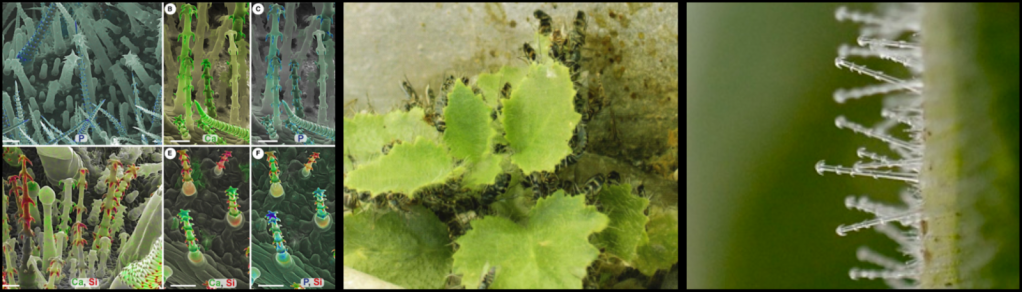
From left to right: Imaging showing biomineralization in Loasaceae trichomes (Mustafa et al., 2017). Photo by Michael Metzler showing trapped hoverflies on E. urens (Metzler, 2006). Photo by Rosemary Glos showing E. urens’ glochidiate trichomes
So Long and Thanks For All the Fish
One of the last things you may expect when traversing to Death Valley National Park, the proverbially “hottest, driest, lowest,” is fish. Yet, here fish are in Salt Creek; someone should really inform these fish they are wildly lost. The fish here are Cyprinodon salinus ssp. salinus, endemic to Death Valley, found only in Salt Creek. Where these hundreds of tiny tropical fish live the water is only a few inches deep, and the water is inundated with a bunch of toxic salts and metals. Despite this brutal habitat they are able to thrive off of the copious algae that grows in the warm waters. This subspecies became isolated here when Lake Manly dried up, retracting their range until it became only this one brutal creek. There is a lot more to say about this genus, but you’ll have to wait for the next section, Ash Meadows. On second thought, let’s start on that right now.


Ash Meadows
To the west of the Spring Mountains in a rather unassuming valley rests a gleaming oasis, the only balm for a weary soul for hundreds of miles. Humans for thousands of years have been making pilgrimages to this site, in reverence of the seemingly endless crystalline water that pours out of the earth. To this day the Nuwuvi and Newe peoples return to their meeting grounds on the now federally controlled Ash Meadows National Wildlife preserve; thousands of tourists also pour into the preserve each year searching for the reasons why this land feels so alive.
Ash Meadows, A Fight for Survival
Ash Meadows became a National Wildlife Refuge in 1984 and two years later became the fourth Ramsar site in the United States (Ash Meadows National Wildlife Refuge | About Us | U.S. Fish & Wildlife Service, 2026), a designation declaring high ecological significance for wetlands. Prior to federal protection and after the land once known as the center of creation for the Newe & Nuwuvi people was colonized, Ash Meadows was troubled. After thousands of years of reverence, settlers in the 1800s hoping to manifest a little destiny in the hottest and driest corner of the state moved in and started to drastically alter the habitat. By the 1900s cattle ranchers diverted flows, eliminated sand dunes, mined all of the precious peat, and pumped much of the precious water out of the earth. The settler’s effect on the land likely caused the death of several endemic species’ populations. The pumping of groundwater threatened several endemic fish populations on Ash Meadows, especially the incredibly rare Devil’s Hole Pupfish, which resulted in a 1976 supreme court decision limiting groundwater pumping to maintain water levels in Devil’s Hole (Cappaert v. United States, 426 U.S. 128 (1976), 2016). Water rights were then sold to a “land development” company who renewed the effort to strip Ash Meadows of its life-giving water and build a new desert housing community nearby; this is finally where the Land Conservancy bought the land rights and transferred them to the Fish and Wildlife Service, giving it protection for the rest of time (Ash Meadows National Wildlife Refuge | About Us | U.S. Fish & Wildlife Service, 2026).

Ah, to have such unbridled optimism. To this day, nearby ranchers and people who lack reverence for this ecological wonder attempt to kill the protected pupfish. More unfortunately with the reelection of Donald Trump as president of the U.S., areas once thought to be protected from such perverse greed have once again become troubled. The Trump Administration has prioritized resource extraction and ordered Secretary Doug Burgum to review the validity of protections on sites like Ash Meadows. Just this year (2026), the Boundary Waters Preserve in Minnesota lost its protections from mining within its watershed. It isn’t unreasonable to think Ash Meadows may face the same fate, especially with a drier and hotter Mojave thanks to climate change and an overtaxed Colorado River; water wars in the Mojave are a likelihood and it seems the voiceless will be the greatest casualty.
The Voiceless
Ash Meadows in the Amargosa Valley west of the Spring Mountains is a rarity. The geothermically heated water that gushes through the earth here is thousands of years old, and the lineages of now endemic species are even older. In semi-recent geological history, this region used to be a bit more tropical and a bit more wet. Species took advantage of this period of abundance and made this region their home, such as the semi-tropical group of fish known as the Pupfish (Cyprinodon). Of course, times-of-plenty never last and the region dried up, leaving just the springs. This rapid climatic change and range retraction left isolated pockets of pupfish in the American Southwest who are now diverging from each other thanks to isolation and inbreeding. As mentioned before, Death Valley has their own unique species, Ash Meadows has three, and there are eight in total, all confined to their own miniature worlds. This story of desperate, resilient survival is shared across 26 endemic taxa found within the refuge, all adapted to only this postage stamp oasis. I will cover a few of the endemic taxa here today, becoming their voice.
The Menagerie
Before we get to the endemic species of Ash Meadows, I think it important to set the scene by mentioning some of the other taxa to be found here.
If you view Ash Meadows from a distance you’ll notice thick, winding bands of sprawling canopies. This is where the water is at its highest concentration. 5 species with tree habits, Neltuma odorata, N. glandulosa, Prosopis pubescens, Fraxinus velutina, and F. anomola, cling to the guaranteed sources of water in this arid environment like their lives depend on it, which it of course, does. The ashes (Fraxinus) are what gives this region its name, and not the ashen appearance the soil can sometimes have due to the salt-crusts. It is uncommon to see ashes- a typically water associated genus- in the middle of the low elevation, scorching-hot Mojave. Yet, in this oasis they thrive. More exciting (in this humble botanist’s opinion) than the ashes is one tree species, Strombocarpa pubescens, more commonly known as screwbean. A state listed vulnerable species (S3), screwbean is an obligate riparian plant. The wonderfully corkscrewed fruit are what gives this wonderful giant bean plant its common name. The fruit of this tree are a common food source for multiple species within Ash Meadows and the seeds require the passage through an animal gut in order to germinate.

Closely associated with the mesquites in the park is a parasitic plant most of you are likely familiar with in name, although likely not with its appearance. Phoradendron californicum, or mesquite mistletoe, is adapted specifically to parasitise mesquite trees; it is likely that if you see a mesquite here you’ll also see mistletoe. The mistletoe serves an important role: keeping the mesquite in line, ensuring the nitrogen-fixing trees don’t get too big and overwhelm the plant communities. The seeds of P. californicum are spread by a specifically punk-looking bird with a funny name: phainopepla. Mistletoe berries are the primary food source for this mohawked bird. As the bird flits from mesquite to mesquite, it eats berries and defecates on the branches, depositing scarified seeds on the waiting stems. This is coevolution in action.

Also found within Ash Meadows on bare, gypsum soils is a species of sparse distribution and listed globally as threatened (G3), the wonderfully wooly Arctomecon merriamii. While not in flower here, the lack of its frilly white flowers is of no real loss, since the dense pubescence evolved to reflect sunlight is enough to keep this botanist enthralled, and yes, it is as soft as it looks. This species lives in a thin latitudinal band in pockets from the northern portion of Death Valley east through Ash Meadows and the southern portion of the Desert National Wildlife Refuge, and just outside Valley of Fire State Park.

In the limestone cliffs surrounding Amargosa Valley, if you are lucky enough, you may stumble upon a truly special plant more common to the adjacent Death Valley, funeral sage. The stark contrast of deep-purple blooms and frosty-white-green, triangular leaves combined with the strong sage scent makes Salvia funerea a wonder to behold. In Nevada, this species is listed as critically imperiled (S1) as there are scant populations outside of its usual range in California where it is doing much better.

Finally, on the gentle slopes surrounding Ash Meadows a tiny member of Polemoniaceae with highly ornamented flowers grows amongst gravel and creosote bush. Langloisia setosissima flowers, with their puprle spots and blue stamens, erupt from a whorl of spiny leaves, a true desert plant if I have ever seen one. For some reason, deserts love the juxtaposition of “fuck-off” and “drop-dead gorgeous.” There are two subspecies of this species, L. setosissima punctata and L. setosissima setosissima. The first subspecies is the one I saw at Ash Meadows, and I later saw ssp. setosissima at Avi Kwa Ame National Monument.


Obviously, there are many more species present here than what I can discuss. I highly recommend checking out my Ash Meadows album on Flickr to get a more in-depth idea of the wonderful plant communities that call this region home. While some of the species listed above certainly can be considered rare and imperiled, it is the endemics in Ash Meadows that really make this oasis a paradise on the brink.
A Rarity Onto Death

The soils of Ash Meadows are influenced by two main factors: leachate from the surrounding mountains and minerals that are brought up from beneath the surface from the several springs and seeps. As moisture evaporates, salts of gypsum and carbonate are left behind, which leaves many areas encrusted in a thick, white layer of alkalinity sat above layers of clay; while this may seem inhospitable to all life, the groundwater is close enough to the surface that roots can tap into a lifeline.
Possibly the most famous of the gypsum-salt-loving plants endemic to Ash Meadows is Astragalus phoenix, a long-lived, mound-forming milkvetch with diminutive, densely pubescent leaves, and lilac-pink flowers. There are only a few locations within the Refuge that this almost camouflaged milkvetch can be found, on gypsum barrens, flats, or knolls. These salty refuges are likely the final home for this branch on the evolutionary tree of Astragalus; with nowhere else to go and a warming climate with higher water needs it is likely this species will experience something we all must become accustomed to, a rarity onto death, extinction. In the Anthropocene, more than a fifth of all plant lineages (not species, whole branches) are at risk of facing this fate (Wang et al., 2026). The upswing of this is in geologic time new species will erupt from the ashes A. phoenix leaves behind. Until that time though, appreciate the struggle this species continues to fight, giving a floral-middle-finger to the humans that have attempted to destroy its home and resilient life.


Growing nearby, nude, glaucous scapes hold upon their delicate pedestals radiant concentrations of sunshine. Compared to Astragalus phoenix, this endemic represents a more restricted evolutionary branch on the tree of life, a variety. Enceliopsis nudicaulis var. corrugata is visibly different from its sister-varieties, with ruffled (corrugate) leaf margins. If you were paying attention to the earlier section on Asteraceae phyllaries, then this species is sure to stun you. Three rows of thick, ashy, pubescent bracts subtend the typical radial flowers unique to Asteraceae. While this species is endemic to just this section of the Amargosa Valley, the sister varieties are sure to carry on the main stem on the evolutionary tree of life.


Also mentioned in Death Valley, Ash Meadows has three endemic taxa of Pupfish, two of which I saw. The species that brought protection to this region, the Devil’s Hole Pupfish, Cyprinodon diabolis, lives only in a single crevice through which the geothermically heated water enters. While technically on the land encompassing Ash Meadows, this area is actually a detached management unit of Death Valley, a reminder that the outflow from Amargosa Valley eventually deposits into the basin of Death Valley. Devil’s Hole is a 500 foot deep cave on the side of a rocky hill through which sunlight streams in, allowing algae to grow on a carbonate shelf (Valley & Us, 2026). In the vicinity of this one algae-covered strip of rock do the 60-500 individuals of this species live out their lives. Conditions such as solar irradiance, nutrient deposition, and surprisingly, tsunamis greatly impact the population. Being connected to a deep underground aquifer, the tiny pool is impacted by seismic activity across the globe. Large earthquakes in faraway countries like Mexico, Japan, or Russia have caused the normally glassy pool to form waves several feet high, dislodging food and eggs from the carbonate shelf and giving these fish a momentary ability to soar through the air. This species is almost guaranteed to perish if not for the intervention and care of humanity. There have been several times where population numbers have dropped dangerously low and captive-breed C. diabolis were released into the pool to great success, although unfortunately due to scientific panic over the Trump administration, we no longer have genetic tracking on which individuals are captive bred (Heidt, 2026), lessening our ability to prevent inbreeding and unintended genetic drift. If you hope to get an up-close glimpse of the pupfish you are out of luck, ever since two divers died in the Hole, a caged overlook is the only access point available to the public. To see pupfish at Ash Meadows you must head outside of Devil’s Hole. Pupfish occupy many of the crystalline outflows found within Ash Meadows. If you go during the breeding season of the pupfish in spring, you’ll be gifted with the electric-blue breeding coloration of the males, who fight other males for prime algae-covered breeding grounds. In the picture below you can see the slightly larger, blue males and the more nondescript females.

After reading through this section on endemics it may occur to you that the endemics here are doomed to die, and that may be true. When species are localized to an island, usually evolutionary pressures go wild on a genome, drifting to strange, new forms. This is likely the main reason there are so many unique taxa at Ash Meadows. The combination of toxic soils, prevalent moisture, and genetic isolation has created a perfect island amongst an ocean of arid sand. There is a slim chance that a few of these endemics have the nucleic-acid-craftiness required to make it to the next geological time period, but for our current era, there is a different reason to care for these lonely branches, their stories.
Charismatic endangered species carry with them a special kind of power, ones which common, yet beautiful, species like Solidago canadensis do not, the ability to spark empathy. The idea of something like the Panda or Devil’s Hole Pupfish struggling to survive, fighting off the inevitable demise inspires within us similar punkish feelings. These poster-children of resilience remind us that even in our own bleak times we can persevere and we cannot always do it on our own. The voiceless at Ash Meadows, if you are willing to listen through unconventional ears, will speak to you their stories.
Spring Mountains
Island in the Sky
To the east of Ash Meadows rests the sprawling carbonate mountains of the Spring Mountain Range. Mt. Charleston towers an impressive 9,000 feet over the adjacent Las Vegas; the Spring Mountains are truly an island in the sky. The plant communities that evolved on the upper elevations are isolated from the other ranges in the Mojave, their genetics limited to only their sympatric siblings. It is no wonder then that this range has the highest concentration of endemic plants of any range in the state of Nevada with 27 taxa. There are a ton of varied habitats and plant communities present here, from alpine to oak scrublands; bristlecone pine forests to sagebrush steppe, the Spring Mountains houses a broad diversity.

Most of the rocks present on the Spring Mountains are sedimentary, with a large percentage being carbonate materials at the higher elevations, such as at Charleston Peak, and sandstone at lower elevations around Red Rock Canyon; the age of the materials present span from the Precambrian to the Cretaceous period, respectively (Burchfiel et al., 1974). To walk from from the Red Rock Canyon Visitor Center to Mt. Sterling peak you’d pass through 478 million years of history and 8,196 feet of elevation (assuming you pass through Mt Charleston). Due to the thrust-faulting that happened at the Spring Mountains, the older material (the carbonate material) was lifted on top of the younger material (the sandstone at Red Rocks) (Burchfiel et al., 1974).
There are more plant communities than you can shake a poplar stick at in the Spring Mountains and I have barely seen a few of them. Nonetheless, in the following sections I will cover a few communities and two endemic plants.
Chance Encounters of the Plant Kind at Red Rock Canyon
Red Rock Canyon is heavily composed of weathered Aztec sandstone, making the soil both sandy and reddish. The towering sandstone edifices are a stark contrast against the white backdrop of the Spring Mountains; at the base of the Red Rocks the giant range almost disappears. Before you reach the sandstone escarpments, you have to hike through an alluvial fan of Mojave desert scrub. Dotting the arroyos leaving the canyons are sprawling canopies of Quercus turbinella, which more so resemble large overgrown shrubs than trees. In much of the gentle slopes or mounds of sandy soil are several cacti species, such as Opuntia polyacantha erinacea, Cylindropuntia acanthocarpa, Opuntia basilaris, Echinocerus engelmannii engelmannii, and Ferocactus cylindraceus. Other prominent species found here are Pinus monophylla, Juniperus osteosperma, Ephedra nevadensis, Calochortus flexuosus, and Dipterostemon capitatus.

As you approach the escarpments, springs gift the sun-bleached landscape with much needed water, and the surrounding rock walls make this section a little cooler than the previous open scrub habitat. It is here where the plant communities take an interesting turn. The plant communities get denser, shrubs intermix readily with forb communities, and wetland associated plants begin to make their appearance. Here you can expect to see Symphoricarpos, Garrya flavescens, Epipactis gigantea, Amsonia tomentosa, Arctostaphylos pungens, Claytonia parviflora, and several species of Penstemon.

I knew that there were oodles of endemic species from the Red Rock Canyon in to the Spring Mountains, but I was not actually expecting to stumble into any. To my surprise I saw two species, neither of which I was knowledgeable enough to identify at the time, and neither of which visibly stood out as remarkable. Yet, remarkable they are.
The Endemics
Both of these species were a surprise to me and I almost missed them entirely for a couple of reasons. Towards the end of a 100 degree day on a loop that headed into the rock escarpments of Red Rock Canyon, I noticed a diverging path that seemed to head deeper in towards what looked like wetland associated communities. I gambled my declining water reserves and headed in deeper. Here is where I saw most of my favorite species and the two endemics thriving on the cool mountain spring.

Astragalus remotus is an globally imperiled (G2) endemic limited entirely to the Spring Mountains. It is a rather unassuming species in my opinion. In a low wet spot adjacent to the spring-fed stream I stopped to take a few pictures of Amsonia tomentosa tomentosa, a showy member of the milkweed family (Apocynaceae) whose range curves from near L.A. to the canyonlands of Utah. Upon wrapping up I noticed a loose raceme of white pea-flowers and I almost decided not to photograph it, but my better instincts of noticing novelty kicked in. The species is usually found in scrublands and gravelly washes, like pictured below. It is a perennial with many ascending, loose racemes, and leaves with small leaflets mostly restricted to the base. There really isn’t much else known about this species other than its uniqueness.


Just around the bend in the trail, growing in duff from P. monophylla, a rather unusual basal rosette common to the thistle tribe, Cardueae, caught my eyes. Once again, I almost walked past it thinking there was no defining features, but that well-honed instinct for novelty prevailed and I quickly found myself photographing the well-armed leaves. Low and behold another endemic to just the Spring Mountains, Cirsium clokeyi.

Center of Hairy-Tongued Diversity
Recently, while scouring the botanical tomes of Nevada I discovered an amazing tidbit of information, the Intermountain West- the mountainous region spanning from Colorado to California- is the center of diversity for the incredible plant genus, Penstemon. There are around 280 species of Penstemon endemic to North and Central America, and it is the largest plant genus native to N. America (Penstemon | Wolfe Lab, 2026). Most species occur in the Intermountain West, with Utah having the largest concentration with 73 species (Penstemon | Wolfe Lab, 2026). Last article that I wrote about the west I became enamored with pollinator selection between Bombus and hummingbirds within Penstemon. This time, seeing the wide diversity of the eponymic beardtongues, I had a different question: why are some staminodes hairy and others aren’t? Another way to phrase this: what’s the selection pressure that makes a beardtongue hairy? Also, what the hell is even the point of a sterile stamen?
Staminodes are a vestigial organ that are homoplasious- that is a shared characteristic not due to a common ancestor- across plant groups. As the name suggests, staminodes are a modified stamen that is no longer fertile and lacking the anther cap. Staminodes can vary quite differently, and this is definitely true in Penstemon where some species can have what resembles pompoms at the tips versus some that are entirely hairless and diminutive. As it turns out, unsurprisingly, staminodes are undergoing selection by their pollinators. Something I noticed after staring at copious Penstemon flowers is that the bee-adapted flowers tend to have hairier, more prominent staminodes than those adapted to hummingbirds (again, read this article for more info), although this isn’t 1:1, there are plenty of non-hairy bee-pollinated Penstemon. According to research involving staminode removal, these vestigial organs are generally being selected for in bee-adapted flowers, and selected against in hummingbird pollinated flowers (Walker-Larsen & Harder, 2001).
Let’s start with the easier subjects: the hummingbird pollinated flowers. Most of the time, the staminodes are glabrous and held near the lower part of the corolla, while the stigma and stamens are usually exerted up top. Hummingbirds, relative to a flower, are powerful creatures with slender beaks and long tongues. Pollination occurs mostly through contact with the foreheads or beak, not on top/back of the head. Any resistance the staminode could provide would not aid in pollination. This was backed up in the Walker-Larsen & Harder research, where staminode removal did not alter seed set.


In contrast, removal of the staminodes in bee-adapted flowers resulted in less seed set (Walker-Larsen & Harder, 2001). As explained in the study, this seemed to happen in two ways:
- The staminode provided a physical impediment to the bee as it struggled to reach the nectar at the back of the corolla. More time in the corolla means more chance of contact with both the stigma and anthers.
- The staminode provided a lifting force on the bee, physically forcing the bee in contact with the anthers and stigma.


In the above photographs of two hummingbird adapted species (P. eatonii & P. utahensis) and the one bee adapted species, P. bicolor you can clearly see these principles in action. The former species’ staminode is recessed within the flower and- you’ll have to take my word on this one- lacking any prominent hairs. For the latter species, the “tongue” is exerted and quite hairy. To see another incredibly hairy beardtongue, check out P. palmeri under the Mojave National Preserve section later.
Speaking of the latter species, Penstemon bicolor (G3, vulnerable) has a case of curiosity baked into it. As of 2020, there were 70 known populations of P. bicolor in Nevada with a maximum estimate of 7,000 individuals (Stone et al., 2020). A population unfortunately facing rapid decline due to expansion from Las Vegas. You may have noticed in the captions of the above photos that it lists the individuals as “varieties,” this is a contentious statement. I was first made aware of this contention thanks to a wonderful Mojave botanist/artist whose Instagram handle is @red_eaglephotography. There are two sub-taxa underneath P. bicolor: var. bicolor (T2, imperiled) and var. roseus (T3, vulnerable), and previously, it was thought that these were subspecies, based upon the obvious morphological floral differences. Natureserve even separately lists each sub-taxon. Some have even argued that these should be classified as separate species. Morphologically, species have been defined on less, and yet, it appears modern evidence does not support this.
Wolfe Lab at my Alma Mater, the Ohio State University, specializes in Penstemon diversity, despite being in a state with a paucity of Penstemon diversity; a good excuse to travel I guess. In 2020, Wolfe Lab looked into the question of speciation between the two proposed subspecies and found several surprising results. Genetic analysis of populations around Vegas and northwestern Arizona of the two putative subspecies found an above average amount of genetic diversity for a rare and declining species, but, no significant genetic differences between the two “subspecies,” (Stone et al., 2020). The same paper goes on to mention how there seems to be slight differences in habitat and populations between the two varieties (as they argue) but this does not seem to be a limit in gene flow. Given enough time, these two varieties could definitely diverge, especially if a population (likely var. roseus) shifts towards a hummingbird pollinator. That is, if we don’t add these varieties to the dead-book; approximately 66% of the populations are of roseus, making the yellow phenotype exceptionally rare. Unless the people in the area begin caring an awful lot about preserving this rare variety, it may soon be on its own island, marooned from any other genetic source, destined to face a rarity onto death.
A Spring (Mountain) In Your Step

There is something magical about driving through this range. Something akin to stepping into an alien world where alien plants live on alien substrates. Here, technicolor-rainbows grow on cooked, lunar regolith. The pale facades of the calcareous rocks gleam in the sunlight; slopes of Yucca woodlands give imaginations of a habitat out of time; and ancient Bristlecone Pines stand as silent sentinels over the Mojave Desert. To bathe in the living world here is truly to feel akin to life separated across geologic time.
Perennial Obsession, Yucca
As an eastern-expat in Nevada I find it curious the differences in interest in this group compared to locals. It seems many Nevadans I meet have been long done with this group. I cannot get myself to hate them. In WPSW Moves West I found out this genera is entirely pollinated by a single oddball genera of moth, Tegiticula. Ever since then I am in awe with every Yucca bloom I encounter. Here, I was able to add two more inflorescences to my have-seen list. On the slopes of Lee Canyon, Yucca predominates. Y. jaegeriana, Y. baccata, and Y. shidigera can all be found on the dry slopes overlooking the Desert National Wildlife Refuge.


On the same slope, rivers of Sphaeralcea ambigua fill the gaps, illuminating the slope in an apricot-hue. Here, I stumbled upon a mutated individual that lacked the apricot pigmentation.

Another prominent member on this slope was a member of Rosaceae that mostly grows in the Mojave Transition Zone and on the edges of the Sonoran Desert, Coleogyne ramosissima. Otherwise known as blackbrush, this species is monotypic, the sole branch tip left on the tree of life. It is a drought-deciduous shrub that tends to dominate in the spaces between the Great Basin Desert and Mojave Desert where sagebrush and creosote are absent.

Succulent Garden
Depending on where you travel in the Spring Mountains you can either see nothing but cacti (usually Opuntia polyacantha var. erinacea) or none at all. In some canyons where the carbonate cliffs tower over you, their tiered ridges shady refuges for scant plant populations, the succulent habit thrives.

Possibly the most exciting succulent found growing on this exposed canyon is Agave utahensis (S3, vulnerable), a long living asparagus relative that puts all of its energy into reproducing. Agaves generally are monocarpic, meaning they produce carpels (fruit) once in their life and then perish from this earth. While technically monocarpic, A. utahensis has a workaround. Each 1 foot tall whorl of leaves produces one towering spike that can be 12 feet tall, and that’s the end of the road for that whorl, but, A. utahensis also clones itself vegetatively by forming side shoots. So, while one whorl has perished another lives on to carry on the genes.

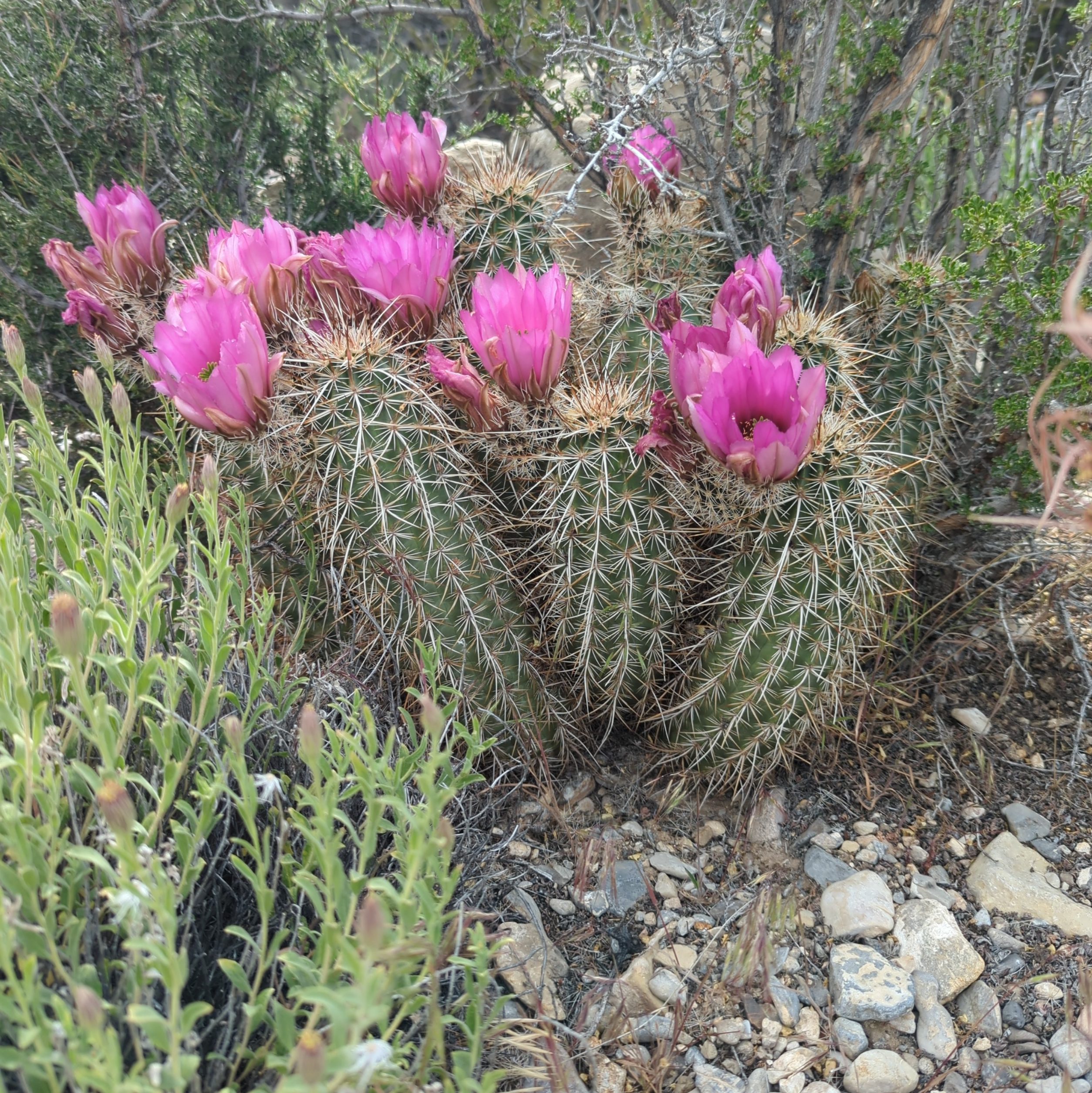
Nearby, a community of several cacti species grow tall despite the relative lack of water in this canyon. Opuntia chlorotica, Escobaria chlorantha, O. polyacantha var. erinacea, Ferocactus cylindraceus, Echinocereus engelmannii var. engelmannii, and Echinocereus triglochidiatus var. mojavensis all grow within a relatively short distance of each other.



In this same dry canyon several other uncommon species make their appearance. Growing in the crevices of limestone where scant shade and moisture collects is the diminutive cheilanthoid fern, Myriopteris gracilis, a group known for its ability to dry out in periods of drought and come back to life when water is present. Another chasmophyte that associates only with limestone cliffs, Petrophytum caespitosum is quite common on the cliffs surrounding the canyon, although this species is not limited to the Mojave and will grow as far north as Montana. A more limited obligate carbonate plant, Buddleja utahensis (S3 vulnerable), grows quite readily here on the edges of the wash. This species was a surprise to me as I recognized the inflorescences from the dreaded “butterfly bush” common to eastern gardens. This cousin though is a native to the Mojave growing along a thin crescent from DVNP, south to Vegas, and back north to St. George, Utah. Finally, two shrubs are very common here Eriodictyon angustifolium and Garrya flavescens. The latter species is an absolute weirdo despite its unassuming appearance. The Ashy Silktassel belongs to the family Garryaceae and the order Garryales, each with only two sub-taxa in each clade. This is a completely unique branch on the evolutionary tree of life. In Nevada, G. flavescens is almost entirely found in the Spring Mountains, but has a broader distribution elsewhere. This order mostly has species in tropical/subtropical climates and desert/forested coastal habitats.


Just down the road from this canyon, at lower elevation, the lithology changes. Limestone soil switches back to red sandstone. Here, oodles of Penstemon eatonii, P. monophylla, J. osteosperma, and Glandularia gooddingii grow.

Most excitingly though, serendipity. Where I decided to camp for the night was next to a slope with large shingles of red sandstone that sounded like broken pottery when walked upon. Here, I stumbled on to a strange pea-member that I assumed to be a weird Lupinus; this was incorrect. Pediomelum castoreum is threatened (S2) in the state of Nevada. The species mostly occupies a diagonal band from Barstow, CA to Beaver, UT, and an extant population in Death Valley.

With most of the upper slopes still sleepily breaking out of dormancy I wrapped up my tour of the Spring Mountains and headed south to somewhere new.
Avi Kwa Ame National Monument
Near the border of southern Nevada and California is a Monument often ignored when discussing scenic areas in Nevada, at the very least, I was never privy to conversations about it. Avi Kwa Ame National Monument is a preserved area of land that peoples from the Mohave, Chemehuevi, and southern Paiute tribes revere as central to their creation stories. For this reason, it gained federal protection. This was an overnight stop for me on my way to the Mojave National Preserve, and a mild curiosity. The large size of it and known populations of Calochortus kennedyi made me want to check it out. I am glad I did. The land here felt buzzing with energy. The night I arrived the Yucca forests were imbued with solar-fire and the ground was littered with species in bloom. Here I saw several new species. I only regret my vehicle was not a little more rugged so that I could more appreciate this land that people have been feeling at home in for centuries.
First up are two cacti species new to me, both globally vulnerable (G3) Echinomastus johnsonii and Grusonia parishii. The second species resembles a Cylindropuntia spp. that suddenly dissolved into a big pile of its individual segments.


Next, several species of Fabaceae. Lupinus flavoculatus (G3), Astragalus nuttalianus (S3), and Dalea mollissima


Finally, a small assortment of other species in this area that I found worthy of including. My favorite, Malacothrix coulteri (S3, vulnerable) has imbricate phyllaries that resemble the scales of a snake.


It is here where in my introduction to the Mojave I recollected feeling alive, blasting Psychedelic Porn Crumpets, flying down the highway, and fully comprehending the unparalleled glory of the Mojave Desert. On my penultimate stretch of my Mojave trip I returned to one of my favorite places on the planet, the Mojave National Preserve.
Mojave National Preserve

An Improbability Made Reality
How can I explain the glory of the Mojave National Preserve of California? A landscape that should by all rights be barren. In the heart of the Mojave the snowpack is scarce, the rainfall even scarer, the wind desiccating, and the sun threatening to transform you into a raisin. Yet, here sits a testament to the adaptability of life. A grandiose diversity of species lives on these 1,542,776 acres, with mountains that reach up to 7,000 feet, valleys that contain several hundred feet tall sand dunes, lava fields, and forests of Yucca jaegeriana.
Granite Boulder Garden
This section comes from 2025, when I visited Mojave National Park for the first time but was too overwhelmed by the loss of the botanical love of my life to write about it. Now, back in Nevada where hope has resurged, I’ve found the strength and inspiration to write about it.
In the southwest corner of the Preserve, your eyes are blessed with an expanse of white granite boulders. From the roadway the boulders seem so small, but up close they yawn higher than you dare to climb. The Granite Mountains are where my mind goes to when the Mojave Desert is mentioned. The photo above introducing the Preserve is from this range, a garden of cacti and yucca on decomposed granite. This is probably the most fun and dangerous hike I had in the Preserve. I was damn determined to climb up the coarse granite boulders to reach some unknown summit. “Is it love or suicide?” to quote the UK band Wet Leg. This tested my burgeoning rock-climbing skills as there were many points where a single slip meant I’d fall ten or more feet down in a gap between the boulders, unlikely to climb back out again. Overcoming the risk, I was rewarded with oodles of new species, some already mentioned in earlier sections, but in the timeline this came first.

Several species of cacti dominated the landscape here, including my favorite cactus yet, Cylindropuntia ramosissima. Other species include, C. echinocarpa, C. acanthocarpa, and Ferocactus cylindraceus and Echinocereus engelmannii engelmannii. The pictures below are from various regions within the Preserve, but are included here for succinctness.


Near the base of the mountains a surprise to me. At first I assumed the species to be a caesalpinoid member of Fabaceae, but upon seeing the anatomy a little closer I was surprised to see something familiar staring back at me. The prior field season working with the Great Basin Institute, two species of this family (Cleomaceae) were on our seed collection list. Cleomella arborea is a surprisingly large shrub mostly native to the Mojave & Baja California, with some scant occurrences up the central valley and coast ranges of California.

The final species here worth mentioning is a succulent I unfortunately had the misfortune of missing the bloom time of, Dudleya saxosa.

While the Granite Mountains didn’t have the most diverse showing of species within the Preserve, fate would have me return in a year to see more species in other ranges.
Sky Islands Part Two: Electric Boogaloo
One of the great joys about the Intermountain West is the way you can drive up in elevation and watch the landscape change from salt-basin communities, to scrub, to subalpine, to alpine, all within several miles if you pick the right area. The next range is no exception. Its upper elevations shift dramatically from the cactus and yucca dominant slopes and creosote bush valleys below. The New York Mountains are at the northeastern portion of the preserve and are also granitic in composition. Fires have altered its upper reaches in recent years, likely sourced from one of the copious fire rings. While the usual reaction to this natural disaster is sadness at the loss of the community that once lived there, in this instance, joy. Penstemon palmeri has taken over the burn scar with thousands of individuals in full bloom. There are several intoxicating features about P. palmeri. First, the individual flowers are approximately two inches long, with a yawning throat, light-pink color, and a very hairy staminode. These flowers are also one of the few Penstemon that put out any perfume, and the perfume smells strongly of a flower shop in mid-May. Finally, there may be many inflorescences per plant and each one can reach up to six feet tall. One of the most impressive specimens of the genus.


Growing alongside the dominant P. palmeri are several other species coming back post burn. Probably the second most common species here is Eriodictyon angustifolium, but, Garrya flavescens, Frangula californica, and Ipomopsis arizonica were also quite common here as well. Finally, just up the way towards the New York Mountains, another new cacti species, Opuntia phaecantha.


Shortly downslope two stunner species I wanted to see revealed themselves to me, Scutellaria mexicana and Eschscholzia californica. The former genus is kind of an obsession with me. Back in Ohio I jumped for joy any time I got to see these classic mint flowers. When I previously learned of this species back in 2025 I scoured the Preserve but failed to witness any in bloom. This time around, I got lucky (or possibly more skilled). Also known as Paperbag Bush, or Bladder Bush, due to the inflated calyx surrounding the zygomorphic mint flower. After germination, the calyx inflates even more, and upon drying out, it does kinda resemble a paper bag. The latter species is a very popular ornamental poppy that has spread as far as Nova Scotia.


Leaving the New York Mountains I made my way to the final destination in the Preserve, the Kelso Dunes.
Life on the Sands
When you picture sand dunes are you imagining sterile mounds of shining sand, too hot to touch? While much of the dunes do contain nothing but shifting sands, a surprising amount of diversity prefers life on the dunes.

The Kelso Dunes rise up ~650 feet above the valley floor that surrounds it. There are fields of un-sloped sand, shifting dunes of sand, dunes that are held together with vegetation, and large bowls of sand that tempt you to fall in them, as if a large antlion sits at the bottom awaiting an unsuspecting victim. This is the largest aeolian (wind-deposited) sand dune in the Mojave. There are several endemic insects home to the Kelso Dunes and several rare species that are even rarer outside of these sandy slopes, such as Uma scoparia. While not specifically here to see animal diversity, I was pleasantly surprised to see a few individuals.

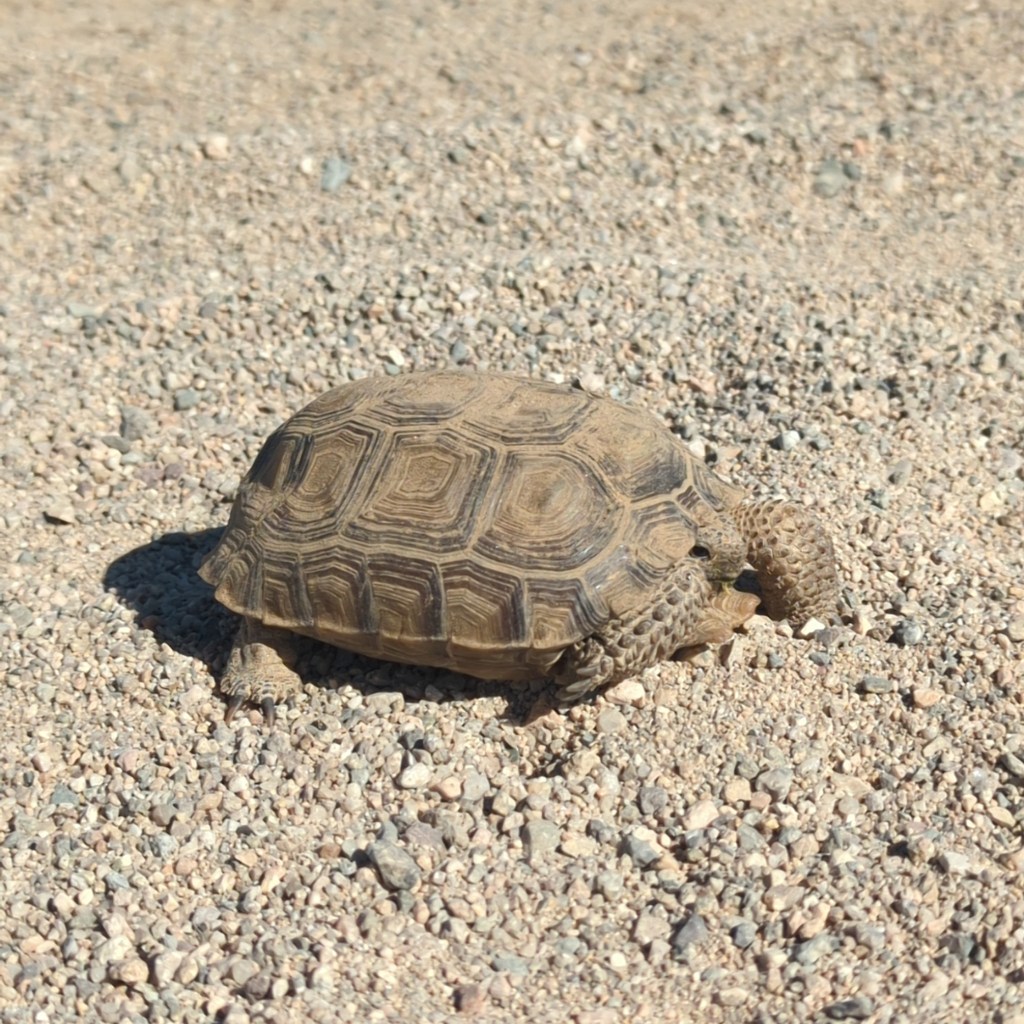
The most exciting, the emblem of the Preserve, the globally imperiled (G2) Gopherus agassizii, or the Desert Tortoise. On the way to Kelso Dunes this lumbering reptile was ploddingly going about its day in the middle of the roadway. There are signs all across the preserve that warn you about driving slow for the tortoise, and in my experience most people on the roadways do not. I am grateful I was, both for its life and so I could witness this beauty of Mojave conservation.
Once I stepped foot in the dunes I became overwhelmed with the instantaneousness of life. Oenoethera deltoides & Baileya pleniradiata bloomed in large swathes along the flatter sand deposits and as I crouched down to observe them, movement caught my eyes. A three-inch-long beetle was spastically climbing from culm to culm, clumsily falling as soon as it reached the pinnacle. I wanted to pick up this curious beetle, but something about the deep orange color near the head stayed my hand. I’m glad I did. Lytta magister is a blister beetle, so aptly named for their ability to cause blisters in would-be predators. Blister beetles are able to pop blood vessels in their leg joints where their smelly and caustic yellow blood oozes out. Gnarly.

The final surprise animal was my favorite. Whereas the desert tortoise was the most exciting, the utter joy when I heard the iconic rattle of the Sidewinder, Crotalus cerastes, stopped me dead in my tracks. I turned to my side and saw the iconic rattle coiled upright against its body, its slitted eyes daring me to come closer, so closer I went, to a respectable 9 feet. As with every rattler I’ve encountered, it allowed me to crouch low, take out my camera and snap a few photos. I only stopped when the snake stopped its rattling and started to slither towards me; 6 feet was close enough. Besides, it was time to see some plants. I was so overwhelmed with joy in this moment that I failed to recognize the second sidewinder’s head behind the rattle; of course in my excitement I’d miss a rattlesnake mating event. I only became aware of this hidden joy thanks to a more observant WPSW follower pointing it out.

The first plant species that stopped me in my tracks following the quick succession of animals was a duo, Mentzelia longiloba and Palafoxia arida. Neither species especially uncommon, but new to me. I was begrieved to have missed the large display of this Loasaceae member, but to be honest, I am just happy to see a new Mentzelia that doesn’t turn out to be M. albicaulis. The aster, P. arida was just the icing on the cake. I always love seeing a discoid aster.


In a similar area of the dunes, I witnessed my favorite weirdo aster in the Preserve, Nicolletia occidentalis. Glaucous and glabrous, the smooth stems invite you to feel its smooth surfaces. Upon doing so, you notice a pungent scent wafting up to meet your nostrils, and as you should always do when touching plants in the desert, you smell your fingers. I describe the smell as an orange just starting to rot. Like so many plants in deserts, N. occidentalis is heavily scented, with orange resin glands on the tips of its leaves and phyllaries. While I would’ve adored getting to see the plant in bloom, the rotten orange scent was enough to satiate this botanist’s fascination with anti-herbivory adaptations.

Much of the dune-adapted individuals I encountered were Mesquite trees or a very fragile grass by the name of Hilaria rigida. I don’t know how this species got those binomials, it was neither hilarious, nor particularly sturdy. While traversing the dunes in search of novelty, once again serendipity struck. I witnessed an odd herbaceous bush whose shriveled purple flowers reminded me of a mint. I shrugged it off and convinced myself INat would tell me what it was later. 50 feet down a sandy bowl I spotted a large bush of vibrant purple and green. Penstemon! Not only Penstemon, but a species I had no hope of encountering, P. thurberi (S3, vulnerable)! P. thurberi is a shrub version of the classic Penstemon form, reaching about 3 feet tall and densely loaded with classic Penstemon flowers.


Eventually I reached one of the pinnacles of the dunes, and felt the lack that was growing in my water bottle. Instead of following that botanical urge to look beyond the next corner, I realized I needed to get back to my vehicle before I became a statistic. With the dunes completed, I hopped back into my jade-green Subaru Forester and headed to my final destination on this Mojave botany excursion.
Valley of Fire State Park

My final stop before heading back up to my new home in Ruby Valley, a two hour glimpse of Valley of Fire State Park north of Las Vegas. Here, the Aztec sandstone of Red Rock Canyon makes a grander appearance. In what might seem like a controversial opinion, I liked what I saw in Valley of Fire more than Arches National Park in Utah. Maybe its my bias towards the Mojave coming out, but the smaller park felt more magical; the magic of the low desert condensed into tight canyons of burning orange. Most people come here to see the copious bighorn sheep that call this region home, and in fact I saw some almost immediately. I even had to convince a tourist not to go up and try and pet a male standing sentinel over two females. While my time here was very brief, I saw several phenomenal species.

The most exciting find was Krameria erecta. This stunning plant is in a family of its own, Krameriaceae, sister to the family containing the dominant Creosote bush. This species is quite deceptive. While it may just look like a pretty shrub, it actually hides a secret under the soil: parasitism. K. erecta is a root parasite. The second deception lay within its flowers. The five magenta structures that resemble petals are actually this flower’s calyces, showy, but false. The real petals are the triangular purple & green structures at the center, with two modified into glands next to the ovary. Gotta love a botanical weirdo.

Nearby, a lovely shrub of the pea family, Psorothamnus fremontii.

Also nearby, another shrub that lives in that crescent from DVNP, south to Vegas, and north to St. George. Mortonia utahensis (S3, vulnerable) belonging to a family not often seen in Nevada, Celastraceae, with only 5 species within the state.

Finally, one of the most common species in bloom within the park, the magnificent Encelia farinosa. This aster is very successful amongst the lowlands of the Mojave and Sonoran deserts and can be found as far south as Baja California.

With the sun setting on the burnt orange rocks behind me, I drove out of the Mojave towards the beginning of my field season with the Great Basin Institute in the Calcareous Mountains Section of eastern Nevada. As I headed north, my mind mired with a menagerie of emotions. The Mojave Desert, despite its scorching heat and declining water supplies, had fully enraptured me. I went into this field season hoping to land an AIM job in the Mojave and Sonoran deserts. Would I enjoy my time in my own “Walden Pond” on the borders of Ruby Lake? Would the three botanists I was housing with be good people to be sardined together for the next six months? What about the rest of the world I was leaving behind? Would I be coming out of this field season to a strange nation with even stranger mores? What about the laws targeting immigrants and transgender individuals; would I return home to find their doorways long cobwebbed from disuse? Lastly, what about the protections afforded towards protected species and habitats; will my work even matter? My answer came a day later amongst a gathering of three botanists made queer by the times we live in.
New Beginnings, Perhaps Hope
Prairie-rock-band bathroom bans,
Big buffalo bounties begotten by bouguois braggards.

Antagonistic alligators' appetites devour families,
Unabashed ant-lions annihilate American attitudes.

Irate ignoramus irritates Iranian ignobles,
Inciting imaginations of mutually assured incineration.

Meanwhile, scientific scholars search for selenium celebrants,
Scouring for the sole psalm of our century's woe:
Hope.

-Lily Rice
We are in uncertain times as nature-lovers. It seems the zeitgeist of the United States has shifted fully away from the attitudes of preservation and preparing for a changing climate. Unfortunately, we are currently losing the political war: losing to the side that classifies transgender people as terrorists, immigrants as rapists and thieves, and endangered species as impediments to progress. The thing to keep in mind is that the tide can turn, minds can change. Long-term droughts in the arid west are causing water to become scarce, and cities like New Orleans are (less) slowly becoming inundated by briny waters. As naturalists- those that carry the voice of the voiceless, those that see that all-too-likely rarity onto death reflected in the species we study back onto us- we must help others see the hope. The hope found in: every doomed branch on the tree of life fighting for their desert oasis, every conservation success story, and every once-thought barren landscape hiding a preponderance of rainbows. To inspire hope in others is to spur praxis. I wrote the above poem after arriving in Ruby Valley, NV. After days of stressful driving, terrible headlines, and a week of botanizing in the Mojave I saw hope yet again germinating in 4 scientists trying to make a change in a landscape wracked by human disturbance.
I made the 36 hour drive from Ohio to my new home by myself this time around. In already uncertain times I stepped into another exhilarating uncertainty. Being a transgender woman, Kansas’ new law revoking all transgender person’s licenses along with a bounty system placed on “illegal” trans bathroom usage frightened me, so this time I headed south through Texas, another frightening uncertainty. Along the way, in one of the many Love’s gas stations along my way I sat down for my lunch of instant mash-potatoes, trail mix, and moka-pot coffee. Here, a man approached me from across the busy highway, walking towards the dinky dog-park lunch table I sat at. He introduced himself as Hobo Boots, asked if I was heading to Kansas, I said no, and then I invited him to a meal. For 45 minutes in Oklahoma we formed a queered meeting of perfect strangers. Hobo Boots and I shared the stories of our lives. We commiserated on our mutual diagnoses of PTSD, how being non-normative often sets us apart in any space we enter, what national parks we loved, what towns will chase you out of town for being a hobo, what it’s like riding the railways, and so on. Hobo Boots told me of a friend that had funded a short-term medical treatment for him in Kansas, if he got himself there, and he was having the most damned time trying to hitchhike out of Oklahoma. An unqueer place for hobos it seems. Something about our brazen honesty and the visible years of resiliency in his eyes showed me how desperate he was to get to Kansas; a chance at a better life. So I gave him $50 to help buy tickets on a greyhound to Kansas, hoping this paltry fund would get him where he needed.
Our conversation reminded me of a verse from Bruce Springsteen’s “The Ghost of Tom Joad.”
"Ma, wherever there's a cop beating a guy,
Wherever a hungry newborn baby cries,
Where there's a fight against the blood and hatred in the air.
Look for me, Mom, I'll be there.
Wherever somebody's fighting for a place to stand,
Or a decent job or a helping hand,
Wherever somebody's struggling to be free,
Look in their eyes, Mom, you'll see me."
You’ll see me.
The lyrics are a reference to Steinbeck’s The Grapes of Wrath, whose main character, Tom Joad, an immigrant laborer recently out of prison, transforms from someone focused solely on their survival in harsh times for laborers and immigrants, to a leader of a larger community focused on helping those oft ignored by society. Joad is an image of resiliency in a time that prioritizes unfettered greed over the lives of those that build such profits. Springsteen wrote these lyrics in the aftermath of Reagan’s economic principles that transferred wealth upwards. Springsteen was hoping to find his generation’s Tom Joad.
The same Reaganomic, egoistic policies that inspired Bruce Springsteen’s cutting lyrics are alive and well again in Trump’s second term, and once again, an artist is looking for the ghost of Tom Joad. Here in the Mojave, resiliency abounds. Plant species dare the scorching sun and wicking winds to stop them as they put out new seeds in the hopes of a better year. Here in the Mojave, rainbows hide against the backdrop of an apparently barren landscape. Here, in the Mojave, in one of the harshest landscapes on the planet, an incredible diversity abounds. For the voiceless in our society, in our country, and our planet, we must find the ghost of Tom Joad in us all and lead others to see the hope that we know.
Citations
Alcock, J. (2010, May 28). Blister Beetles | Ask A Biologist. https://askabiologist.asu.edu/explore/big-bad-beetle
Ash Meadows National Wildlife Refuge | About Us | U.S. Fish & Wildlife Service. (n.d.). Retrieved May 7, 2026, from https://www.fws.gov/refuge/ash-meadows
Burchfiel, B., Fleck, R., Secor, D., Vincelette, R., & Davis, G. (1974). Geology of the Spring Mountains, Nevada. Geological Society of America Bulletin, 85, 1013–1022.
Cappaert v. United States, 426 U.S. 128 (1976). (n.d.). Justia Law. Retrieved May 7, 2026, from https://supreme.justia.com/cases/federal/us/426/128/
Carnegie’s Cactus: Carnegie gigantea. (n.d.). Retrieved April 27, 2026, from https://carnegiemnh.org/carnegies-cactus/
Cockrum, E. L., Currier, W. W., de Vos, A., Allin, A. E., Handley, C. O., Cope, J. B., Packard, F. M., Trapido, H., Hardy, R., Ulmer, F. A., Hayward, C. L., Wetzel, R. M., Gunderson, H. L., & Palmer, R. S. (1949). General Notes. Journal of Mammalogy, 30(4), 427–438. https://doi.org/10.2307/1375222
Court Overturns Trump Administration Regulations That Weakened Endangered Species Act. (n.d.). Center for Biological Diversity. Retrieved April 26, 2026, from https://biologicaldiversity.org/w/news/press-releases/court-overturns-trump-administration-regulations-that-weakened-endangered-species-act-2026-03-31/
Death Valley National Park—NASA Science. (2006, April 16). https://science.nasa.gov/earth/earth-observatory/death-valley-national-park-6470/
Eisner, T., Eisner, M., & Hoebeke, E. R. (1998). When Defense Backfires: Detrimental Effect of a Plant’s Protective Trichomes on an Insect Beneficial to the Plant. Proceedings of the National Academy of Sciences of the United States of America, 95(8), 4410–4414.
Heidt, A. (2026, May 11). National Park Service scientists lost track of the world’s rarest fish. SFGate. SFGate. https://www.sfgate.com/national-parks/article/devils-hole-pupfish-death-valley-22252960.php
Manuel, D. (2023, July 29). O’ODHAM COMMUNITIES PARTNER FOR ANNUAL HAṢAÑ BAHIDAG HARVEST | O’Odham Action News. https://oan.srpmic-nsn.gov/oodham-communities-partner-for-annual-ha%e1%b9%a3an-bahidag-harvest/
Metzler, M. (2006, December). Journal of the international carnivorous plant society. Carnivorous Plants. Retrieved April 22, 2025, from https://cpn.carnivorousplants.org/articles/CPNv35n4p119_121.pdf.
Milman, O. (2025, February 21). Outcry as Trump withdraws support for research that mentions ‘climate.’ The Guardian. https://www.theguardian.com/environment/2025/feb/21/trump-scientific-research-climate
Mustafa, A., Ensikat, H.-J., & Weigend, M. (2017). Ontogeny and the process of biomineralization in the trichomes of Loasaceae. American Journal of Botany, 104(3), 367–378. JSTOR.
National Park Service. (2024, May 15). Weather—Death Valley National Park (U.S. National Park Service). National Park Service. https://www.nps.gov/deva/planyourvisit/weather.html
Our Dynamic Desert. (n.d.-b). Retrieved May 21, 2026, from https://pubs.usgs.gov/of/2004/1007/geologic.html
Penstemon | Wolfe Lab. (n.d.). Retrieved May 11, 2026, from https://wolfelab.asc.ohio-state.edu/penstemon.php
Saguaro Cacti at Saguaro National Park (U.S. National Park Service). (n.d.). Retrieved April 27, 2026, from https://www.nps.gov/articles/000/sagu-saguaro-cacti-plant-story.htm
Stone, B., Hauck, J., & Wolfe, A. (2020). Little genetic distinction between varieties of Pinto Beardtongue (Penstemon bicolor, Plantaginaceae), a rare plant native to the Mojave Desert on JSTOR. https://www.jstor.org/stable/27099297?seq=6
Trump Fired The Entire National Science Board. Here’s Why That Matters. (n.d.). Retrieved April 26, 2026, from https://www.forbes.com/sites/johndrake/2026/04/25/trump-fired-the-entire-national-science-board-heres-why-that-matters/
Tucson, M. A. 3693 S. O. S. T., & Us, A. 85730 P. 520 733-5153 ` C. (n.d.). Saguaro—Saguaro National Park (U.S. National Park Service). Retrieved April 27, 2026, from https://www.nps.gov/sagu/learn/nature/saguaro.htm
Valley, M. A. P. O. B. 579 D., & Us, C. 92328 P. 760 786-3200 C. (n.d.). Devils Hole—Death Valley National Park (U.S. National Park Service). Retrieved May 9, 2026, from https://www.nps.gov/deva/learn/nature/devils-hole.htm
Walker-Larsen, J., & Harder, L. D. (2001). Vestigial Organs as Opportunities for Functional Innovation: The Example of the Penstemon Staminode. Evolution, 55(3), 477–487. https://doi.org/10.1111/j.0014-3820.2001.tb00782.x
Wang, J., Oliveira, B. F., Moore, F. C., Kozar, D. J., Fu, Y., & Dong, X. (2026). Climate-induced range shifts support local plant diversity but don’t reduce extinction risk. Science, 392(6798), 648–654. https://doi.org/10.1126/science.aea1676
We’ve grown the future of botany here. Why are we cutting its roots? (2025, October 2). The Duke Chronicle. https://dukechronicle.com/article/weve-grown-the-future-of-botany-here-20251002
World Meteorological Organization. (2025, July 31). Records of Weather and Climate Extremes. World Meteorological Organization. https://wmo.int/files/records-of-weather-and-climate-extremes-table


Leave a Reply