Nevada endemic plants map Dropbox link
Recently, two members of the Nevada Native Plant Society and the Museum of Natural History at the University of Nevada- Arnold (Jerry, by those who know him) Tiehm, and Jan Nachlinger- Reno published an annotated checklist of Nevada’s vascular flora. This publication is the fruit of over 50 years of labor by the pair, and the direct result of many botanists collecting specimens and submitting them to herbariums across the region. The last (and only other) time a Nevada flora was published was over 100 years ago in 1925. It is with great joy that I was able to interview Jerry and Jan as a part of the 50th anniversary Nevada Native Plant Society’s Newsletter, where I discussed their retrospectives and the future of botany within the state, prior to the release of Nevada Vascular Plants An Annotated Checklist of the State’s Botanical Diversity, which if you’re curious of viewing either, you can check out the links below.
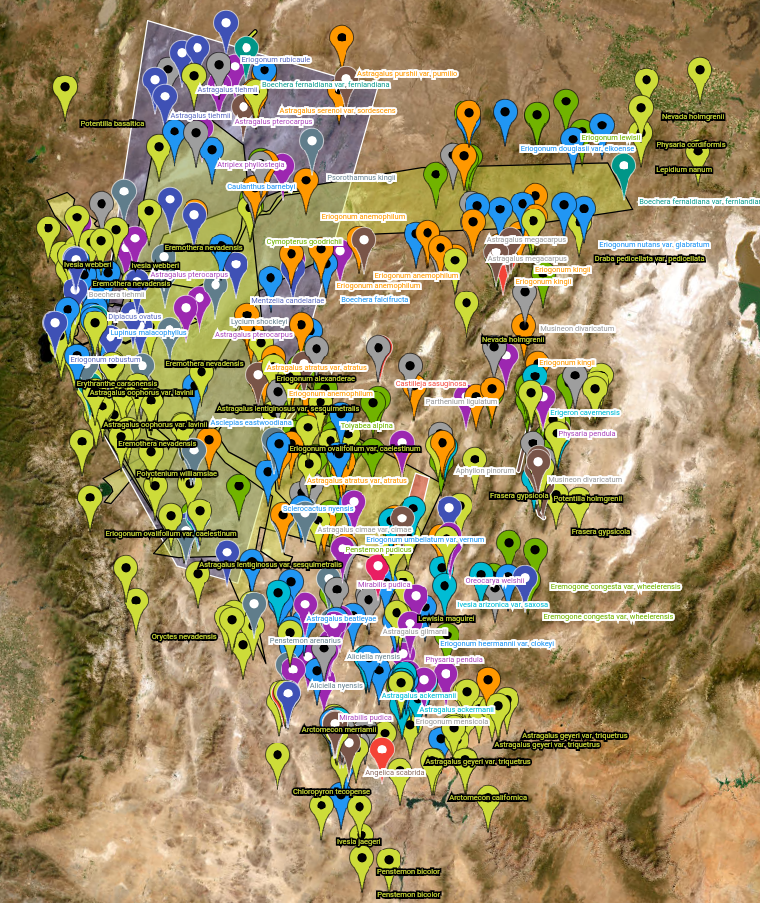
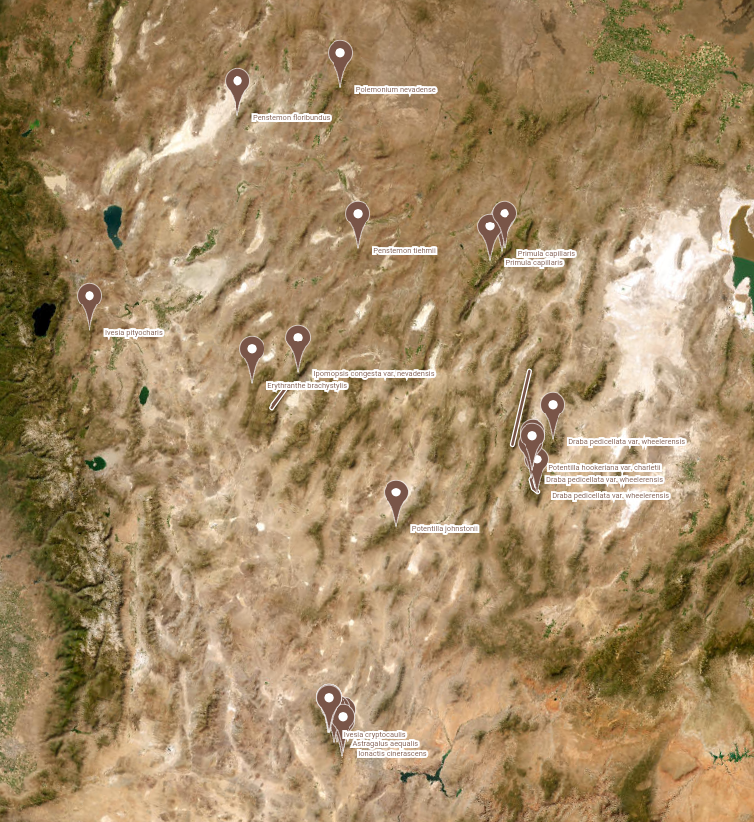
The checklist spends a great deal of the first section discussing the endemic plants of Nevada, as the authors believe these to be Nevada’s greatest contribution to Western U.S. floristics are the endemic species. Nevada, after all, is a large state with unique geology and hydrology that exhibits strong selective effects on the species there. After reading through the annotated checklist I found myself wishing that a map containing the distributions of all 133 endemic plants was published along side it. This of course would be quite cumbersome to include in a physical format, so, using my free time and newfound motivation I have created such map for those interested.
The link above is a Dropbox link containing a KML file that you can put into Google Earth or another platform such as MapMarker, which is the application I utilized when making this. When uploaded, this file has separate categories based upon the categories identified in Tiehm & Nachlinger’s Nevada Vascular Flora. You can filter the individual categories or mix and match to get a better picture. After some deliberation I decided to include the near endemics and disjunct species, since they both contribute meaningfully to the vicariance barriers Nevada possesses, and plants don’t give a damn about state borders. Finally, here are a few notes on the POIs (points of interest) that you’ll encounter in this file.
- Most species listed in Nevada Vascular Flora have specific range limits detailing their outermost points. Instead of trying to highlight every single point these species exist, I instead have opted to use single markers showing such range limits. You can filter by species so this should have a similar effect.
- In a similar vein, instead of trying to mark specifically where each species was found I have placed the markers generically where was mentioned in Nevada Vascular Flora; that is, unless they specifically mention a location. If you want more specifics, check the referenced page in each POI.
- You will notice that many POIs are clustered around an area. Like before, instead of trying to find specifics, I stuck to generalities. For example: many species were cited in White River Valley in Nye county; I used the localities maps (Fig 2 & 3) to place the POIs for this and all other locations mentioned.
- There were a few instances where no specific locations were mentioned but they listed broad distributions of counties, such as Sarcobatus baileyi on page 26. Additionally, there were a few instances where specific and restricted localities were mentioned, such as Tripterocalyx crux-maltae on page 27 or Sphaeralcea caespitosa var. williamsiae on page 13. In these such instances I opted to use polygons to best show the potential ranges.
- Lastly, there were a few species that were listed with very restricted distributions, generally on a single mountain ridge. Here I used lines to show the distribution.
- As a final note, this is not meant to guide you directly to each species, nor to show exactly where the plants are. This is to give a general idea where endemism can be found and what areas of the state have the most endemic species clustered within their boundaries.
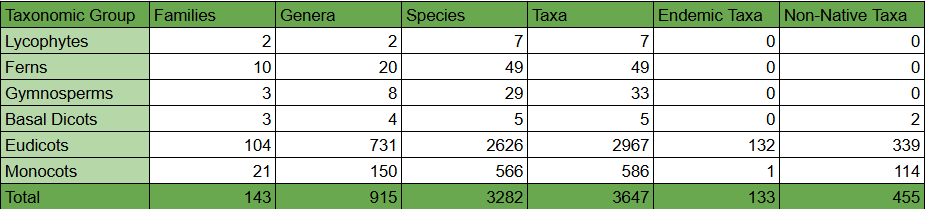
To wrap up this post, here is a Table 4 from Nevada Vascular Flora found on page 7 which details the diversity across taxonomic groups found in the state of Nevada. If all of this has you educationally tantalized I hope you purchase the publication from the link above.
 Watching Plant Sex in the Woods
Leave a comment