Man, I love a good wetland.
You might be wondering, what the hell is a fen? We don’t often hear the word “fen.” Most people likely have an image in their heads when they hear someone speak about swamps or bogs, but fens to most are still an enigma. Prior to 2020, I had no clue what a fen was, until my friend and I went to Cedar Bog, the most plant-diverse area in Ohio, located just north of Dayton, Ohio. Cedar Bog is a fantastic place, I highly recommend anyone to make a pilgrimage there, especially the 2nd-3rd week in June where Cypripedium reginae is in bloom. Although, if I could fault Cedar Bog for one thing, it’s that they are falsely advertised. Cedar Bog is not a bog at all, but a fen.
Fens are a type of wetland habitat that consist of low available soil nutrients, sphagnum peat-moss carpets, and rare plant species- much like bogs. Where these two ecosystems differ comes down to hydrology. Simply put, bogs have stagnant water, fens have flowing water; fens flow, bogs don’t go. Less simply put, fens are fed through mineralized ground water, which has an alkalinizing effect on the ecosystem, and bogs are generally fed by rain water which collects in stagnant depressions in the landscape, which has an acidifying effect.

Thank you all for staying with me so far.
Fens are often a transitional period between aquatic and terrestrial ecosystems. For the fen I hiked to, this was exemplified by the transition from a hardwood forest, to fen, and finally to a rich conifer swamp, which was fed by the Hickey Creek. The hike through the ecosystems was one of rapid change. For 20 minutes you find your way through open, mosquito and deer-fly infested woods before it suddenly ends. For your struggles the sun bathes you in its warmth and you can see for hundreds of yards as you step into the open fen. While the landscape of the fen looks rather homogenized, diversity is hidden amongst the duotone of greens and browns. Hidden amongst the tall sedges are smatterings of plants you’ll struggle to find elsewhere. At the edge of the fen-swamp border lay another important transition zone: horizontal flows of water next to a thick Poplar, Tamarack, and Arborvitae swamp. But, I’m getting ahead of myself, let’s head back into the fen for now.
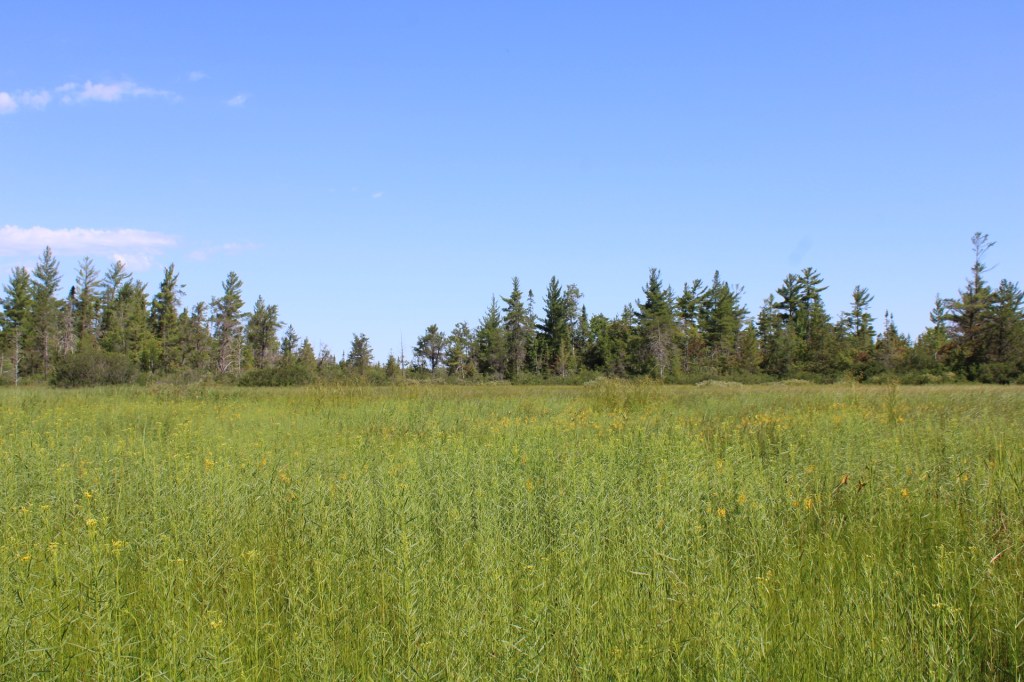
Fens are typically most wet in spring and least wet in late summer, when the water table is lower. In late July when I hiked through, the ground was solid, and only got wet near the swamp boundary. The fen I hiked through is technically a poor fen, which is just a fancy classification that delineates a wetland predominated by higher acidity and more reliant on rainfall than rich fens (Cohen et. Al, 2015), which tend to be more alkaline. It is possible for poor fens to become bogs in time with enough peat accumulation and rising acidity.
If it seems as though I’m talking ad nauseam about hydrology and geography, there’s a good reason for that- plant life is directly dictated by those two variables across all ecosystems.
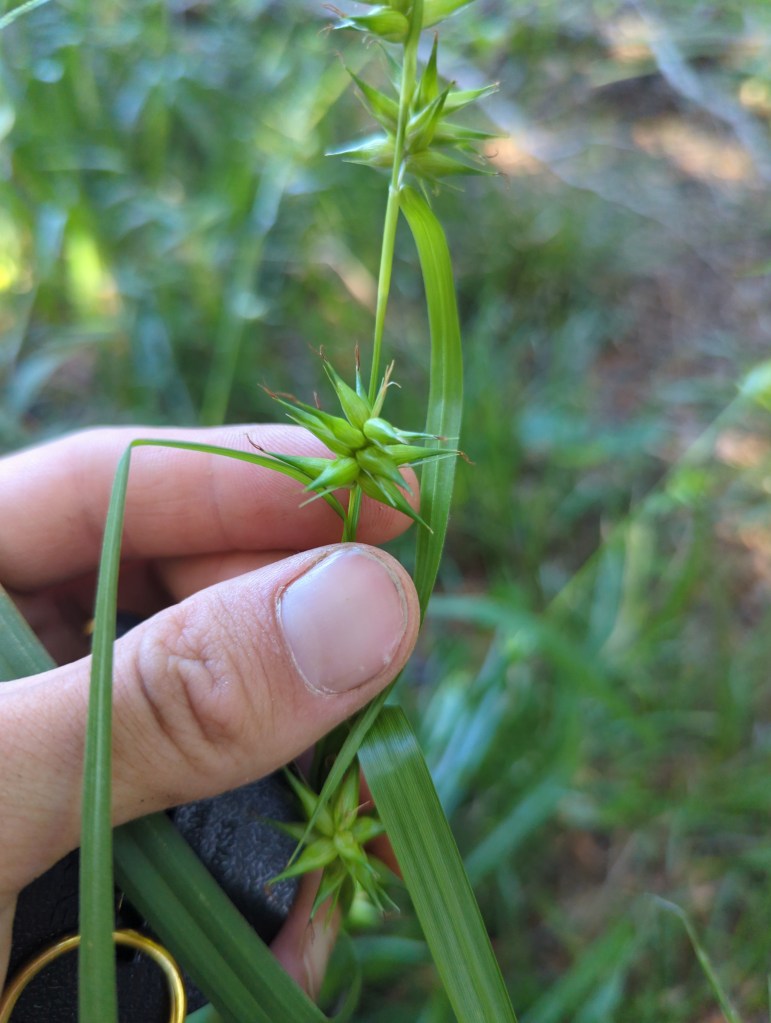
For the fen, the plant community is dominated by species of sedges. Sedges are like grasses, but not really. For the untrained eye (myself included) they look rather similar: thin, reedy plants with a cluster of dull “grains” at the tips. To differentiate the two, a major truism is grass has flat leaf blades, and sedges have triangular leaf blades that you can roll between your fingers. Almost half of all sedge species (2,000/5,500) belong to the genus Carex, which is only 1/90 genera in Cyperaceae (Hipp, 2007). Many sedges are endangered due to a human desire to drain wetlands for agricultural use- or if you’re from central Ohio, to construct the state’s capital. Sedges are most often found in wetlands or areas with poor soil- attributes which fens and bogs have in spades.


Now that we’ve gotten those hard to ID beauties out of the way, let’s discuss the less prominent members of the fen. I’ve previously discussed the orchids of this ecosystem, and I won’t be discussing them here- click here for that post.
The first species I encountered after freeing myself from the mosquito-laden woods were Swamp Candles, Lysimachia terrestris, and Blue Flag Iris, Iris versicolor, members of the families Primulaceae and Iridaceae respectively. A little (not so) secret about me is I. versicolor is on my top 10 list of favorite native plants. I also have a passing interest in the loosestrife genus, Lysimachia, as many members of that genus have foregone nectar rewards in place of oils, which the bees of the genus, Macropis, happily use it to build their nests.


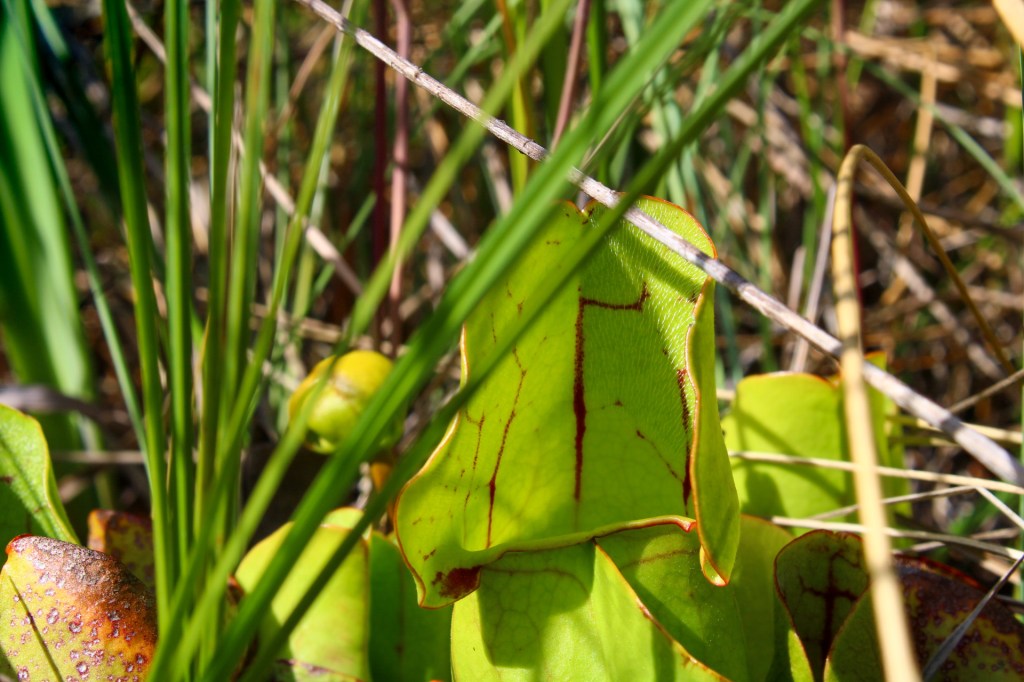
Moving further into the fen I began to see old friends and new acquaintances. The first forbs- for the botanically uninitiated this is a non-woody plant with broad leaves- after the swarms of L. terrestris & I. versicolor were Sarracenia purpurea & Platanthera lacera, who were nestled in a shady spot next to shrubs and young Arborvitae. The sight of these two organisms showed me that my pre-hike researching was well spent. Soon after these two species, the landscape opened her floodgates, and new species appeared everywhere. Such as Kalm’s St. John’s Wort, Hypericum kalmianum, is a shrubby species of St. John’s Wort, and its range is restricted to the Great Lakes and Southeastern Canada.
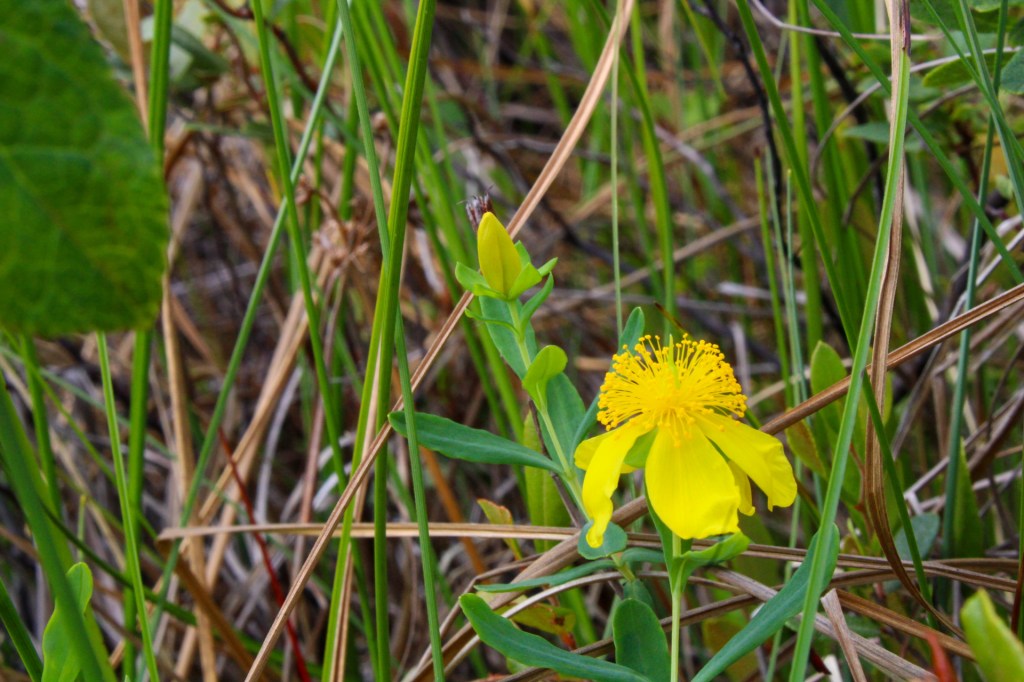


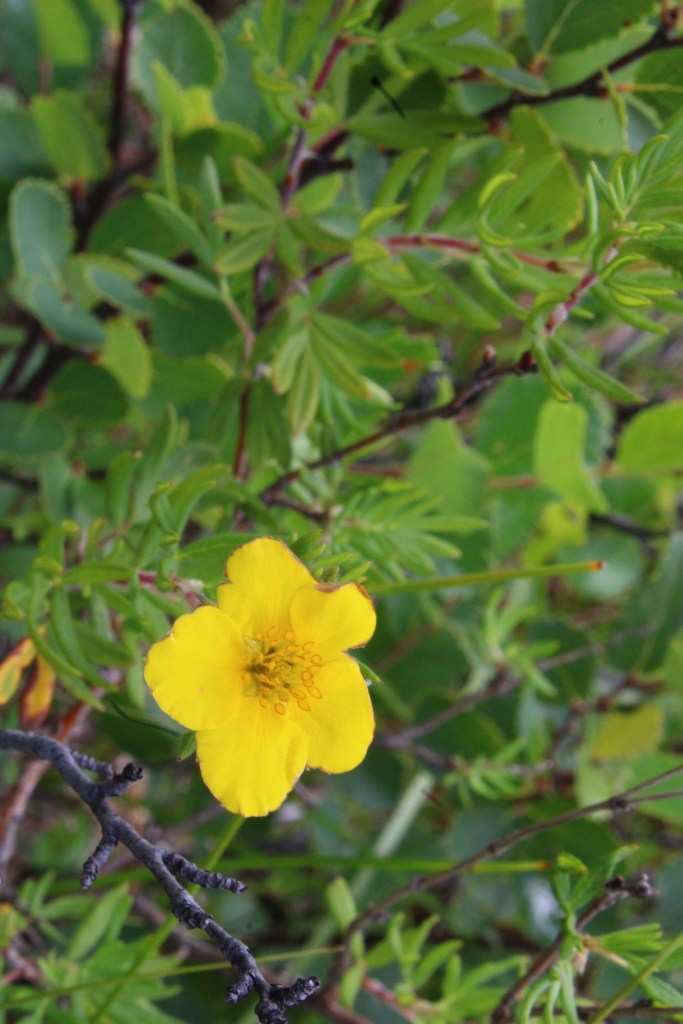
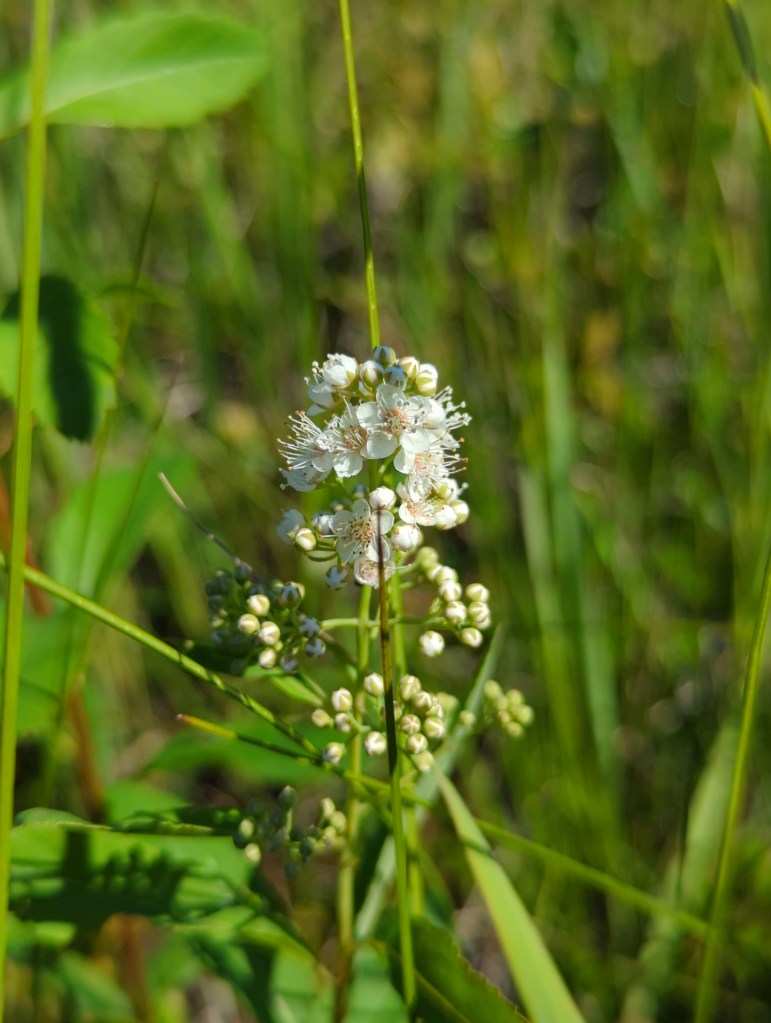
As I was hiking towards the conifer swamp I encountered several more interesting fen-members. First up is a native, vining honeysuckle that I saw for the first time back in Cedar Bog, Lonicera dioica. Compared to the invasive Amur Honeysuckle that dominates the woods back down in southern OH where I’m from, Glaucous Honeysuckle is quite lovely. It’s so lovely in fact, that it’s become a semi-popular ornamental plant amongst many gardeners. Dasiphora fruticosa is another native turned ornamental, and one of the few Cinquefoils that is actually native to our region. Finally, Spiraea alba, a member of the rose family, Rosaceae, dotted the edge of the fen-swamp border.
Saying goodbye to the fen, I went into the edges of the swamp.
Looking back, I’d much rather have stayed in the fen than venture deep into the swamp, for the hike ahead was quite nightmarish. Every step was a struggle to move as the openness of the fen was quickly eclipsed by choking thickets of Black Spruce, Poplars, Tamarack, Arborvitae, and Labrador Tea. The deeper I travelled, the ground became less stable. My choice of ground to hike on was limited mostly to either mossy hummocks, water-laden muck, or felled trees. To make matters worse, the Arborvitae lose their lower limbs as they grow larger, which leaves large jagged stubs which I now have to break back or climb through a-la Mission Impossible to progress through the swamp.
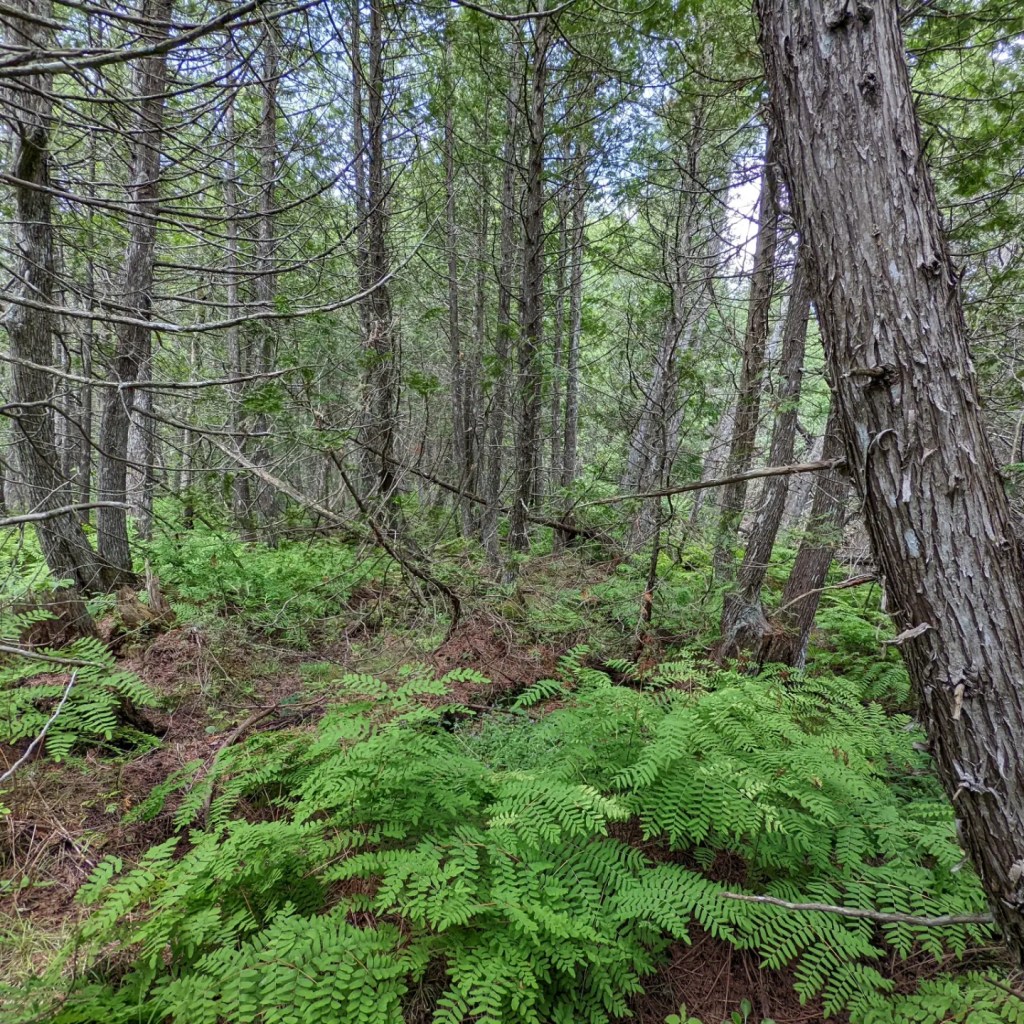
I may sound rather negative towards this swamp, but in all honesty I’d hike through it again If I was more prepared. The isolation the swamp provided was sublimely eerie, especially when thunderclouds cracked overhead before passing by.
Rich conifer swamps are defined obviously by their conifers, but the hydrology of these areas are what allows the ecosystem to flourish. Hickey Creek forms the beating heart of the swamp, pushing alkaline, calcium rich water through the inundated soil. Unfortunately I forgot to take photos of Hickey Creek. By the time I reached Hickey Creek I realized how much extra time it took to hike through the swamp and I needed to head back right then or else I’d be in the swamp until nightfall. Sometimes you gotta change plans when you hike. Lesson learned- it will take you more time to hike through a new area, especially thick wetlands.
Another critical component of conifer swamps are something you may be familiar with, but have yet to hear a name tied to it: windthrows (Cohen, 2015) Windthrows are areas of disturbance in forests where trees uproot and fall over. This chaos leaves gaps in the canopy which allows herbaceous & shrubby species to flourish, until tree species eventually claim the gap in the canopy once again.

It was at this windswept location that I spotted the most stunning Swamp Milkweed species I have ever seen.

Asclepias incarnata is found most often in sunny areas, and this was the first and only individual I saw during my swamp-tromp. Without the windthrown trees, it’s unlikely the deep magenta flowers would’ve had their chance to pass on their genes.
The remainder of my hike back to my pickup location yielded few species of interest, probably due to my rush to get back. Platanthera clavellata is a species I’ve already discussed in my orchid post, so again, I won’t go into any more detail there. I will say that I did try a redcurrant and was met with literal, bitter disappointment.

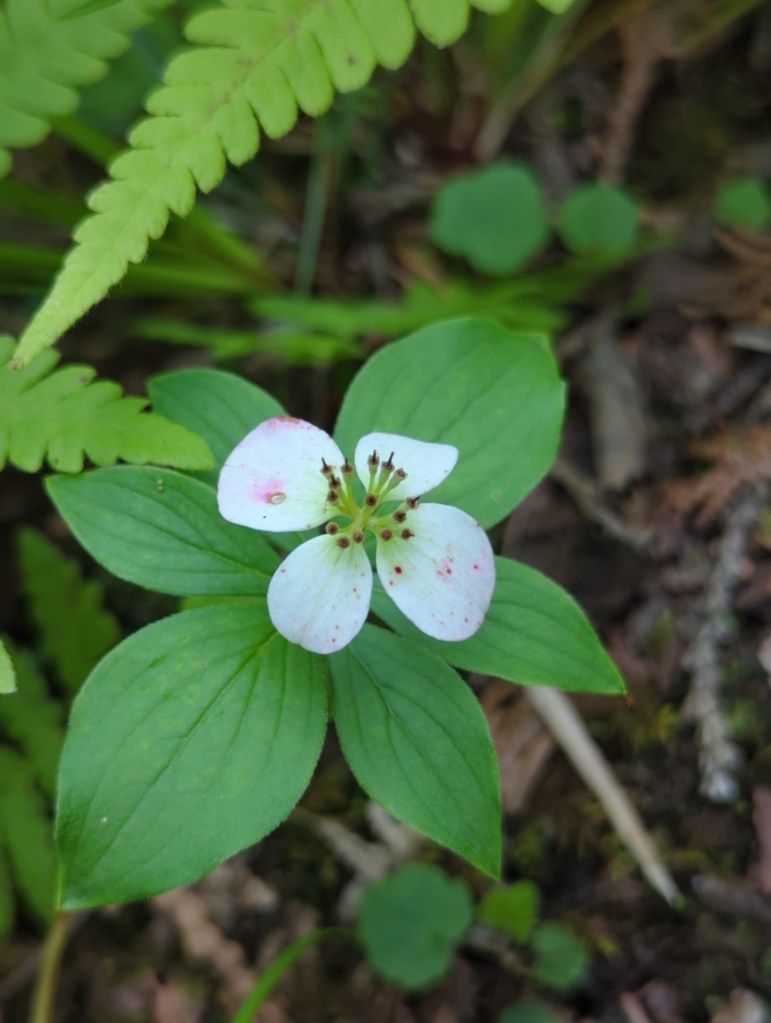
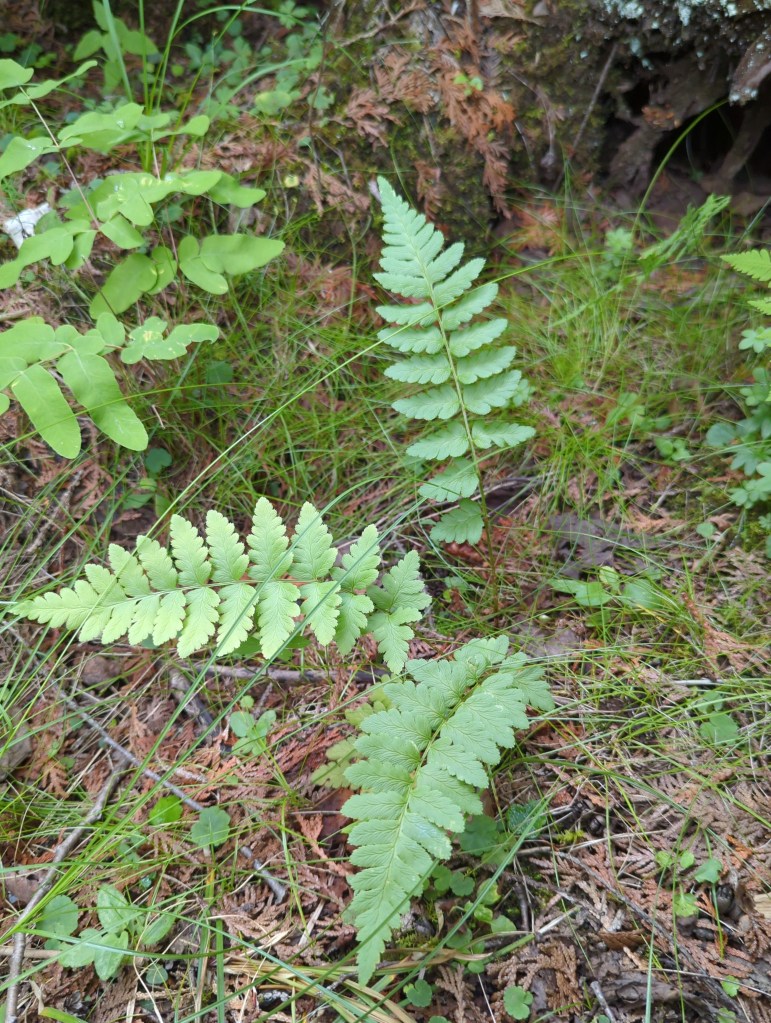


I believe my hike through the Shingleton-fen was a watershed moment for me. The experience of putting my skills to work and finally coming to fruition showed me that I am able to pursue this passion professionally. As climate change continues to alter our ecosystems, it’s important that we understand how our wetlands work and how we can work to conserve them for our collective futures.
I hope that my exploits engaged you and got you curious about these enigmatic systems.

Citations:
1. Hipp, Andrew L. “Nonuniform Processes of Chromosome Evolution in Sedges (Carex: Cyperaceae).” Evolution, vol. 61, no. 9, 2007, pp. 2175–2194., https://doi.org/10.1111/j.1558-5646.2007.00183.x.
2. Cohen, Joshua G., et al. “Poor Fen.” A Field Guide to the Natural Communities of Michigan, Michigan State Univiversity Press, East Lansing, MI, 2015.
3. Cohen, Joshua G., et al. “Rich Conifer Swamp .” A Field Guide to the Natural Communities of Michigan, Michigan State Univiversity Press, East Lansing, MI, 2015.
 Watching Plant Sex in the Woods
Leave a comment